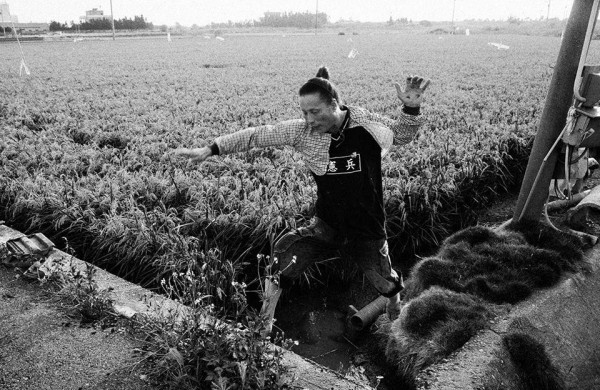
Natural farming rice cultivation and sun-drying the grain, Wang Guixian has always insisted
Text and photos: Chang Liang-yi
What! Look at the time of year - and there is still a first rice crop that has not been harvested! Doesn't rice farming always follow the rhythm of the solar terms? Don't farmers always plough the fields, transplant the seedlings, and cut the rice together with everyone else? Isn't everyone always racing against the season and the crowd? How could anyone transplant seedlings only in the sixth month? Can rice grown this way survive? Can it produce grain?
Wang Kuei-hsien graduated from Chiayi Agricultural College. With her hair in a ponytail and a headband, in Kouhu, Yunlin - a conservative farming village at the tail end of the wind and the water - she grows rice her own way. Because her ideas are too far ahead of their time and her methods too subversive, the neighbours either curse her or make cutting remarks, and her father's generation even chased her and beat her with sticks!
Wang Kuei-hsien grows rice using natural farming, without pesticides, without chemical fertiliser, and without herbicides. She says that every year in June, the water of the Zhuoshui River is released down to their side, and because the river water and silt of the Zhuoshui River are rich in nutrients, she puts off transplanting until June - by which time everyone else is already preparing to harvest.
Taiwan has many typhoons in summer, and farmers worry that the rice will lodge and the harvest be soaked, so they dodge them whenever they can, cutting the rice before the typhoon season as far as possible. But Wang Kuei-hsien is not especially worried. She says that because she uses no chemical fertiliser, the rice has to survive on its own strength, so the roots reach both deep and far, and the stems are sturdier, so naturally they can withstand the battering of typhoons!
Wang Kuei-hsien uses no pesticides and no herbicides. In her rice fields there are fish, shrimp, turtles, frogs, snakes and bird eggs; the soil is alive, and the ecology is rich and diverse - a sight that is hard to see again in rice fields managed with conventional farming methods!
In the first year or two after she began growing rice, the harvested grain had no sales channel: she sold only one or two hundred jin of rice, and on top of having to help her family repay debts, she was so short of money that for a time she could only pick wild vegetables from the field ridges and catch tilapia in the fields to eat. Moreover, because of congenital polio, Wang Kuei-hsien can work with only one hand and one leg, so she has to sweat more than others, and her insistence on natural farming only highlights all the more that what stretches before her is a long and lonely road.
Wang Kuei-hsien's rice will be harvested in another day or two. True to natural farming, she naturally dries the grain in the sun, as handed down by her forebears, rather than drying it by machine - and she does not dry it for just three or four days, but for seven or eight days or more! As I write this, I really want to taste the rice she grows! Wang Kuei-hsien's rice is priced only a little above ordinary rice; she says everyone should have the chance to eat natural, healthy rice!