Ducks Love to Gossip and Lay Eggs Together, So Duck Farmers Sleeping Until They Wake Up Naturally Is No Dream
Has the little yellow duck swum to Taipei? The Yilan Branch of the Livestock Research Institute recently publicly demonstrated its latest "automated egg collection equipment and technology for laying ducks," getting egg-laying ducks that love to "wander all over" to dutifully lay in the collection area, then gathering the eggs via a conveyor belt, so that egg farmers no longer have to get up in the small hours every day and bend over painfully to pick up duck eggs. At the demonstration site, a mini version of the little yellow duck stood in for a laying duck, drawing many members of the public to stop and take photos.
This equipment, touted as letting "duck farmers sleep until they wake up naturally," is Taiwan's first waterfowl egg collection facility. It officially went into operation at duck farms this year, and although it can greatly reduce labor, some farmers reported that the ducks did not dutifully lay in the collection area; other farmers said that rather than training ducks to obey, it is more practical to just collect the eggs yourself.
Egg Collector Automatically Conveys Duck Eggs, Farmers "Sleep Until They Wake Up Naturally Every Day"
In the film "Duck Keepers," the owner had to drive the ducks back to their nests every evening, and the sight of thousands of ducks moving as a group was quite spectacular; but when ducks lay eggs, they are not obedient at all. Unlike laying hens, which are kept in "cages," most ducks in Taiwan are kept in "floor housing," and ducks can "wander everywhere" to lay their eggs. Duck farmers mostly use discarded tires, wooden partitions or boxes, spread with rice husks and straw, as nesting boxes to attract ducks to lay.
Because female ducks mostly lay between evening and the next morning, farmers, to avoid the eggs being trampled or soiled, must get up at four in the morning to collect duck eggs, and since the nesting boxes are mostly placed on the ground, farmers must constantly bend down to pick up the eggs while carrying heavy egg baskets as they move around, which is a great physical burden for elderly farmers.
To address the above problems for duck egg farmers, the Yilan Branch of the Livestock Research Institute developed "automated egg collection equipment and technology for laying ducks," using wooden partitions to design individual laying compartments, with a slope connected at the rear, so that when ducks enter the laying compartment and lay an egg, the egg automatically rolls onto the collection belt. Each laying compartment is about 300 cm wide and can be expanded and connected according to the size of the duck house. For a duck house with 3,000 laying ducks, traditional farmers need to spend 6 hours a day bending over and bowing their heads to collect eggs; after applying this system, that is greatly shortened to 1 hour.
Zheng Zhixiang, a researcher at the Yilan Branch who was in charge of the development, said that Taiwan produces more than 400 million duck eggs each year, and every one of them is diligently picked up by farmers bending over, but in recent years, with the shortage of rural labor, fewer and fewer people are willing to collect duck eggs. This equipment can also be combined with automated conveyor belts, and in the future farmers will only need to go to a fixed place to collect eggs, and "can sleep until they wake up naturally every day."
According to statistics from the Council of Agriculture, Taiwan exports processed duck eggs such as salted eggs and century eggs to Hong Kong, China, Europe and the United States, and Southeast Asia, reaching 16 million eggs each year, creating about 120 million in output value; but with traditional duck laying methods, duck eggs often have duck droppings attached, affecting the quality of processed duck eggs. This equipment can not only improve the cleanliness of the eggshells, but also reduce the proportion of broken eggs, improving the quality and hygiene of Taiwan's processed duck eggs.
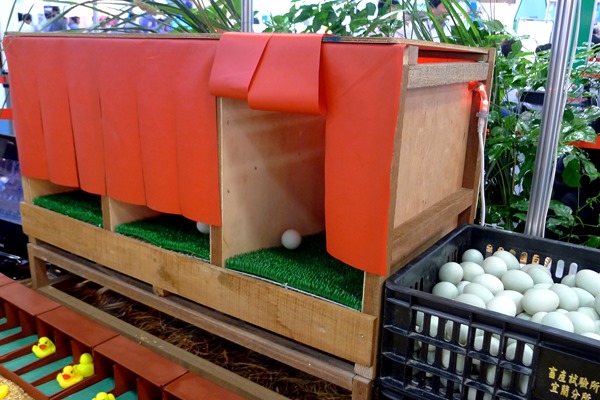
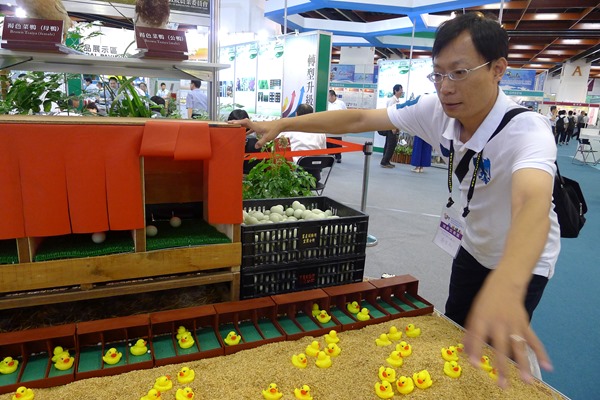
40 Percent of Ducks Will Not Enter the Laying Area, Equipment Still Needs Improvement
This system was successfully developed the year before last, and the technology was transferred to manufacturers last year. It has already been adopted by three duck farms in Pingtung, Tainan and Chiayi, but the price is not low; the Livestock Research Institute initially estimates about 400,000 per set. But Zheng Zhixiang stressed that similar equipment abroad costs 800,000 to 1,000,000 per set, and if it can be mass-produced in the future, the price will become more affordable.
Pan Xuhuang, who runs a duck farm in Pingtung, believes that manpower for collecting eggs has indeed been in short supply in recent years, but he questions that duck farmers mostly buy 120-day-old, nearly mature laying ducks from breeding duck farms, and the ducks lay eggs half a month after purchase, so there is simply no time to train them; moreover, the machine cost is too high, and it is more practical to collect the eggs yourself, "and it can also provide part-time work opportunities in rural areas along the way."
Duck farms that have tried the equipment report that there are still many ducks that refuse to obediently lay inside the collection area, laying outside it instead. Zheng Zhixiang admitted that the branch's trials were on a scale of at most only 400 ducks, while ordinary duck farms often have thousands, and in actual tests, 40 percent of ducks still would not enter the laying area, so further research and improvement are still needed.
Zheng Zhixiang stressed that the age of ducks suitable for this system must be under 100 days, and interested farmers can refer to the user manual available from the Livestock Research Institute. He stressed that rural labor is becoming increasingly scarce, duck farms may also move toward large-scale raising, and with rising environmental awareness, laying duck farms will inevitably have to improve quality and save labor and water, so this equipment has promising prospects.
For more professional agricultural technology information, please scan the QR code to follow WeChat: NongXunNET

Please indicate the source when reprinting.