What are the implications of the pesticide residue tolerance controversy? Kuo Hua-jen offers an in-depth interpretation
By Guo Huaren (Professor Emeritus, Department of Agronomy, National Taiwan University)
The incident over the adjustment of pesticide residue tolerance limits caused quite a stir, and after coordination among all parties, it has temporarily come to a close. The Council of Agriculture put forward six conclusions, including 1. strengthening risk communication, 2. disclosing new drug applications, 3. fully revealing background information on new drugs, 4. establishing a cross-ministerial food safety platform, 5. explaining policy in detail, and 6. promptly promoting the Plant Physician Act. On the one hand, the public learned more about pesticides, and public opinion was properly eased; on the other hand, the government made progress in risk communication techniques, and governance can be expected to improve effectively. Amid the recent performance of various government ministries in civic communication, this stands out as commendable.
However, over the past half month we have seen a number of sensational, polarized headlines in the media, first "Tsai Ing-wen guards herself strictly against being poisoned yet 'poisons' the people of Taiwan," and then "Science lost! The Food and Drug Administration could not withstand the populism stirred up by politicians." The former hijacks political purposes, while the latter treats science as gospel; both are unacceptable attitudes.
In fact, this incident highlights a phenomenon common throughout the world: a gulf exists between the official and expert side on the one hand and the public on the other. This gulf comes from the high wall of science and technology. The government should serve as a bridge, coordinating in the middle, but due to certain factors, civil society groups became dissatisfied with pesticide policy and therefore launched a movement appealing to the masses. The masses generally do not trust the government, and therefore by extension do not much trust what experts say either, which leaves the experts indignant.
There have already been many articles analyzing and commenting on this incident. This article will discuss the hidden causes behind the incident. If the causes are not addressed directly, similar situations will probably keep happening.
A gulf: agrochemical companies deceive society and manipulate officials, leading to a crisis of trust
On food safety issues, consumers do not trust authority; the example of Britain's mad cow disease is the most famous. Before the severity had spread, Britain's Ministry of Agriculture, Fisheries and Food (MAFF), in order to look after the enormous interests of the livestock industry, used "no evidence shows harm" as a pretext and tried to cover up the truth to avoid the losses operators would suffer from slaughtering diseased cattle. Its approach was to suppress and discredit scientists who told the truth, and to put prominent scholars who stood on the same side as industry in charge of investigations; the conclusions of the investigations were of course that there was no problem, and big officials were even trotted out holding their own children to perform eating beef burgers, to reassure the public.
But officials and certain scholars joined forces to cover up the truth, missed the golden opportunity for prevention, and caused 180,000 cattle in Britain to be infected, 4.4 million cattle to be slaughtered, and one to two hundred people to die. It is generally believed that the particular caution of European people about food safety issues, and their refusal to casually believe the words of officials, operators and scholars, began from that point.
In food safety storms, officials performing eating stunts is an old trope seen at home and abroad. Though often mocked by voters, officials never tire of it; unexpectedly, experts can play this game too. Kevin Folta, professor and chair of the Department of Horticultural Sciences at the University of Florida, stated that he had drunk herbicide containing glyphosate (Roundup), and he was accused of taking money from Monsanto[1]. Dr. Patrick Moore, a turncoat from Greenpeace, spent years greenwashing for corporations. He once appeared on a French television program and said that swallowing a quart of Roundup was harmless. When the host invited him to drink it, he fled the scene on the spot[2].
The case of glyphosate herbicide[3] best illustrates how agrochemical companies deceive society, manipulate officials, and suppress upright experts.
Although Monsanto's own pre-market evaluation tests showed that glyphosate was harmful to animals, this was kept secret, and advertisements said glyphosate was safer than table salt, harmless to birds, fish and mammals, and broke down rapidly in soil, and in 1996 and 2007 the company faced lawsuits in New York State and France respectively, and was ordered to withdraw the advertisements or pay fines.
Afterward, research reports on glyphosate harming microorganisms, animals, and even human cells came out one after another, and by 2015 nearly two hundred had accumulated[4]. Based on multiple lines of evidence, the WHO's International Agency for Research on Cancer (IARC) in 2015 classified glyphosate as carcinogenic to animals and "probably carcinogenic" to humans. Afterward, the European Food Safety Authority (EFSA) and the U.S. Environmental Protection Agency (EPA) both rebutted this, holding that glyphosate was "unlikely to be carcinogenic" to humans.
However, the committee members specially recruited by IARC come from expert ranks around the world, and compared with EFSA and EPA, should be less susceptible to interference from corporations. In fact, including Wendy Tse Yared, president of the European Cancer League, Lisette van Vliet, senior policy adviser at the European Union Health and Environment Alliance (HEAL), and Christopher Portier, a Swiss environmental toxicology scholar who once served as a division director at the U.S. Centers for Disease Control and Prevention, all individually or as lead authors publicly criticized EFSA's impropriety.
More than twenty European civil society groups even launched a petition with a million signatures demanding a permanent ban on glyphosate[5].
American civil society organizations also obtained evidence through freedom of information laws, showing that Monsanto, through EPA division director Jess Rowland, intimidated the agency's toxicology expert Marion Copley and demanded changes to the content of the glyphosate assessment report so as to suit industry interests. Therefore members of Congress have already demanded an investigation[6]. With such incidents in the newspapers, and still expecting consumers to trust authority, is that not like climbing a tree to seek fish?
Deeper causes: what loopholes may appear in government review?
Of course most officials do not bend the law for personal gain, and most experts uphold academic ethics and refuse to be lured by corporate interests, but whether officials and scholars have enough moral courage to reveal what they know and hear is something that can be further explored.
Setting aside a few dirty matters, the current official review mechanism, as well as the management of pesticide sales and use after approval, still has its blind spots. Therefore the actual situation is that pesticides do indeed harm the environment and health; this has already become a "consensus" among many in the medical field and among consumers, and this consensus is supported by much research:
In a report submitted to the United Nations General Assembly in early March, the Human Rights Council listed many documents explaining that the impact of pesticide use on the environment and human health has reached the point of violating human rights[7]. The report sharply criticized the large companies that manufacture pesticides, holding that they systematically deny the harms of pesticides, employ provocative and unethical marketing strategies, vigorously lobby governments, and influence academia, thereby obstructing reform and paralyzing comprehensive action to restrict pesticides.
So what loopholes may appear in government review?
Taking our country's official review process, pesticide companies first submit pesticide applications to the Council of Agriculture's Taiwan Agricultural Chemicals and Toxic Substances Research Institute, attaching various research reports provided by (usually foreign) pharmaceutical companies on toxicology, environmental fate and transport, and field residues, which are delivered to institute experts for review. Other data related to regional factors, such as field efficacy, residues and phytotoxicity, are tested by the companies themselves or commissioned to domestic experimental and improvement stations. Domestic test results are given to the Council of Agriculture's Bureau of Animal and Plant Health Inspection and Quarantine, which decides whether to issue a pesticide registration certificate. The documents written by manufacturers after expert review are then used by the Ministry of Health and Welfare's Food and Drug Administration to set residue tolerance limits.
It should be pointed out here in particular that although the Food and Drug Administration, which is responsible for matters affecting human health, has human health as its core business, it does not directly inquire into the pharmacological test reports submitted by manufacturers, relying only on the review results written by toxic substance experts. And the Environmental Protection Administration, which is in charge of environmental affairs, has no voice at all.
Science keeps evolving, but reviews are not conducted again
In short, the authorities believe that throughout this series of processes, everything is assessed by scientific methods. But is this really scientific? First, pharmaceutical companies spend big money developing new drugs, and of course hope to quickly pass review and go on the market to make money. So, if their own toxicology test results carry a risk of failing the review, will these companies honestly submit them?
Of course official review has its internationally recognized guidelines, and pharmaceutical companies need to conduct it themselves or commission qualified laboratories according to these guidelines. However, guidelines have their limits, and so do scientific methods. This can explain why quite a few drugs, after going on the market, only later had evidence of health and environmental risks discovered through tests by independent research institutions on various sides. The aforementioned glyphosate is one example. Yet according to the official process, there is no need to review again in response to later reports not from the pharmaceutical companies, unless the companies voluntarily submit them, but that is very hard to expect.
In addition, official agencies reviewing the test reports submitted by pharmaceutical companies may still make mistakes. Even if the reviewing experts have received strict training and possess rich experience, they may still not understand new knowledge well enough. Even the best experts may reach different judgments on the same set of test reports; this has happened abroad in the past as well. Many experts believe in science, holding that science is precise, objective and universal. Such thinking may be partly correct, but it is by no means an unchallengeable truth.
In addition, many pesticides are called environmental hormones; at extremely low concentrations they have endocrine-disrupting effects, and long-term exposure can affect development, growth and even reproduction. This part is not considered when calculating residue tolerance limits. And it is often found that a batch of agricultural products contains residues of multiple pesticides, which may produce additive effects. This cocktail effect has so far not been taken seriously by various countries[8]. The European Union only recently agreed to study it, and immediately a paper pointed out the existence of such effects.
Improper pesticide use triggers consumer crises, which cannot be solved by "populist" accusations
As for the management of pesticide sales and use, that goes without saying. How pesticide salespeople sell pesticides, how farmers use pesticides, and how residue testing sampling no longer meets statistical requirements are all things everyone tacitly understands.
Why is it that although the government has regulations, the public finds it hard to comply? There are also inevitable reasons for this: pesticides are not necessarily effective, and even if effective, after long use pathogens may develop resistance and render them ineffective. This makes farmers listen to the salespeople and use multiple pesticides, and worse businessmen may even give them smuggled banned drugs, making government regulations sometimes exist in name only. News of pesticide residues exceeding standards or banned pesticides being found is then hard to avoid, causing consumer panic.
Clearly, the application of pesticides involves far more than science, and its complexity cannot be solved by blaming consumers for "populism."
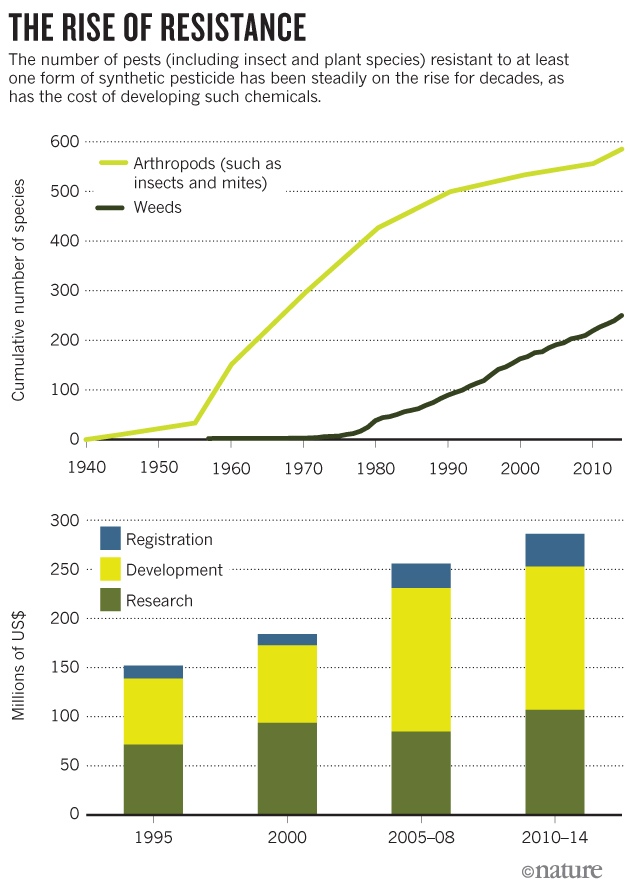
 http://www.nature.com/news/crispr-microbes-and-more-are-joining-the-war-against-crop-killers-1.21633
The dead end of pesticides? "Uniformity" is the fatal weakness of conventional agriculture
A recent article in the journal Nature[9] mentions that, without even discussing those not yet discovered, based on what has been recorded alone, 586 species of arthropods, 235 species of fungi and 252 species of weeds have each developed resistance to at least one pesticide, so the demand for new pesticides is extremely urgent. However, in the past decade or so, new drugs have almost never appeared. There are various reasons for this, but the fact that the cost of research and development and review has increased considerably compared with the past is enough to make pharmaceutical companies shrink back, let alone the difficulty of telling when a product will become ineffective after going on the market.
Of course pharmaceutical companies are no pushovers either. They have long since started a new line, shifting their research and development direction to microorganisms, including directly inoculating insecticidal microorganisms, developing RNA interference technology, or cloning insecticidal genes into crops through genetic modification technology. Although insecticidal GM crops have been proven to also trigger pest resistance, scientists still place hope in gene editing technology, hoping to extend the market life of GM crops.
However, the key reason chemical pesticides and current GM technology become ineffective lies in "uniformity," and uniformity is the fatal weakness of conventional agriculture. Therefore, if this principle is not abandoned, even new technologies such as microbial pesticides cannot guarantee a once-and-for-all solution.
In response to the predicament of pesticides, the aforementioned United Nations Human Rights Council report once again reaffirmed the call made by the United Nations system in recent years, namely "to shift from the current paradigm of industrialized farming methods and the globalized food system to ecological organic farming methods, small farmers, and local food systems based on local production for local consumption[10]."
Quite a few agricultural officials and experts still believe that without pesticides and chemical fertilizers, agricultural production cannot be carried out. Apart from being blind to the positive conclusions of many ecological organic agriculture research reports and the factual existence of many organic farms, this is mainly due to the difficulty of changing the "view of agriculture." They still take the current agricultural production model as a matter of course, not realizing that from another angle, one would understand that pesticides are not a matter of course, and that conventional agriculture being controlled by corporations is how unreasonable a thing.
Conclusion: risk communication is not "preaching"; review the review and management process anew
Of course, transforming from conventional to organic cannot be achieved overnight, so the troubles of pesticide use will continue in the foreseeable future, and consumers' doubts about pesticides still cannot be eliminated. If the Council of Agriculture's six conclusions can be implemented, and if the competent authorities and officials can, like in this communication meeting, play well the role of "public servants" and treat consumers, not manufacturers, as honored guests.
If experts can recognize the shortcomings of science and that a momentary judgment is not necessarily free of error, then risk communication will not degenerate into preaching to the masses, and policy explanations will not become government propaganda. If so, it is believed that civil society groups and the media can also view pesticide policy more rationally, and governance will proceed more smoothly.
Of course, during this transitional period, in addition to the six conclusions, official review still needs to be strengthened, including regularly reviewing the literature published in journal papers and proactively reviewing the applicability of pesticides; environmental hormones and the cocktail effect should also be taken into consideration. In addition, toxicology testing expertise is in fact the Food and Drug Administration's own line of work, and the Environmental Protection Administration should also shoulder the responsibility of gatekeeping in environmental toxicology, so the review and management process can be reviewed anew. More importantly, it is necessary to recognize the trend that pesticides have no future, and gradually reduce pesticide use, so as to achieve sustainable agricultural management.
[1] http://www.gmwatch.org/news/latest-news/16340-kevin-folta-received-25-000-from-monsanto
[2] https://www.facebook.com/warren.kuo.5/posts/10152613350581008
[3] http://gmo.agron.ntu.edu.tw/biosafety/glyphosate.htm
[4] http://www.greenmedinfo.com/toxic-ingredient/glyphosate-formulations
[5] https://www.newsmarket.com.tw/blog/93773/
[6] http://gmo.agron.ntu.edu.tw/GMOmain28.htm#17-03-19.2
[7] http://seed.agron.ntu.edu.tw/publication/article20170307.html
[8] http://seed.agron.ntu.edu.tw/publication/article20170321.html
[9] http://www.nature.com/news/crispr-microbes-and-more-are-joining-the-war-against-crop-killers-1.21633 . The cover of the PDF says WHEN THE PESTICIDES RUN OUT.
[10] http://seed.agron.ntu.edu.tw/organic/paper/20131012-1.htm
For more professional agricultural science and technology information, please scan the QR code to follow WeChat: NongXunNET

Please indicate the source when reprinting.