How to order seafood sushi? Ordering this way in Japan is super easy
Spring cherry blossoms are in full bloom in Japan, and with the spring break upon us, many Taiwanese travelers are getting ready to fly to Japan to taste mouth-watering seafood sushi -- but faced with a Japanese menu, they have no idea where to start. The Eastern Marine Biology Research Center of the Fisheries Research Institute has specially compiled 50 common ingredients found in affordable sushi restaurants, such as Japanese horse mackerel, red sea bream, Pacific saury and octopus, with their katakana names, common names, and Chinese and English names, so that people traveling abroad can both broaden their knowledge and order directly, enjoying the "freshest" ingredients.
50 common seafood comparisons: eating sushi can make you a taxonomist too
The Fisheries Research Institute recently released the "Japanese-Chinese name comparison chart of common fish, shrimp and shellfish in Japanese eateries," which covers in one sweep the Japanese katakana names, romanized spelling, kanji, Chinese names, Chinese common names, English names and scientific names of common ingredients on the plate, instantly upgrading the public to seafood sushi experts.
Liu En-liang, who was responsible for compiling the chart, guarantees it: of the 50 kinds of seafood listed, more than half can be seen in affordable conveyor-belt sushi restaurants priced at 180 to 300 yen. He lived in Nagoya for 5 years and is now a researcher at the Eastern Marine Biology Research Center of the Fisheries Research Institute. He said that during his time in Japan he found that Japanese people are quite familiar with seafood and would not confuse even common names, so he hoped to provide a simple chart so that people traveling to Japan could broaden their horizons while enjoying good food.
He said the chart contains only common ingredients, and if one were to name those that can be enjoyed throughout Japan, they would be red sea bream and Japanese horse mackerel.
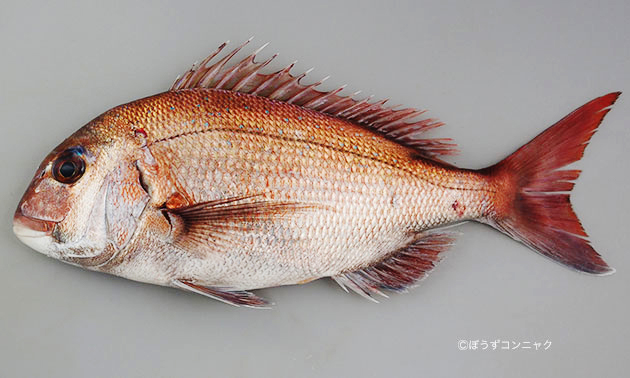
Red sea bream is called "マダイ (madai)" in Japanese, and is mainly distributed in the northwestern Pacific region including Japan, China, and Taiwan and the Penghu islands; it appears on the continental shelf, in muddy and sandy areas, and in reef areas, is produced almost year-round, and migrates to shallow waters to spawn between April and June. Its flesh is fine and tender, and it is quite suitable for pan-frying, deep-frying, charcoal grilling, or making into high-grade sashimi.
Japanese horse mackerel is written in katakana as "マアジ (ma-aji)" and in kanji as (pronounced the same as "sao"). It is likewise distributed in the northwestern Pacific region, and one type, the black horse mackerel, migrates to Taiwan; it has a slender body and a firm texture. Horse mackerel is also one of the recommended edible fish in the "Taiwan Seafood Selection Guide" compiled by Shao Kuang-chao of the Academia Sinica, being abundant in number and catchable in coastal waters.


At conveyor-belt sushi restaurants, freshly ordered is still the freshest
However, when eating raw and fresh foods, food safety deserves particular attention. For example, at the end of June last year, a norovirus outbreak infected 108 people on Green Island after they ate oysters (raw oysters), but investigation revealed that the oysters the restaurant operator purchased from an upstream seafood company were labeled "must be cooked" on the outer packaging but were used as raw food, which is what caused the food safety incident Xu Cheng-yu, general manager of Upwelling Ocean, said that basically Japan is very particular about food safety, and at the aquaculture source, oysters for "raw consumption" are farmed separately, and after downstream packaging there will also be the words "can be eaten raw," thereby avoiding norovirus contamination. In fact, Liu En-liang said that even though conveyor-belt sushi is covered with lids to keep it fresh, sashimi and sushi are still best when fresh, so the chart also provides romanized spelling. "The public only needs to take it out to order directly and immediately taste the fresh, freshly made flavor." He laughed and said that in Japan many gourmets simply order directly rather than taking sushi from the conveyor belt to eat. In addition, Japan is often criticized for being a major consumer of the world's fishery products, so are there any endangered species on the recommended list? Liu En-liang said that aside from tuna, all the ingredients listed are fish catches in sufficient quantities, and the public can eat them with peace of mind. According to the latest report by Agriculture and Agri-Food Canada, Japan ranks second in the world in import volume after China, with imports worth about 16.2 billion Canadian dollars in 2012 (about 401.2 billion New Taiwan dollars), mainly from China, Chile, Thailand, Russia and the United States, with product categories mainly frozen and processed shrimp, frozen fish and fish fillets; and Japan's Ministry of Agriculture, Forestry and Fisheries also statistics show that the average annual fishery production value reaches more than 7 trillion yen (about 200 billion New Taiwan dollars). For example, although the most criticized endangered species, bluefin tuna, is still on the menu, Kinki University has confirmed it has developed a way to stably produce bluefin tuna through full-cycle aquaculture without relying on catching fry from the ocean. However, he also said that bluefin tuna is a high-end consumer item, so many feed inputs are needed during the rearing period, "roughly 15 kg of feed is needed to produce 1 kg of fish meat." With such high costs, it may be impossible to achieve market value.Japan can artificially breed even tuna, hoping to solve overfishing
However, Xu Cheng-yu said that even though Japan's consumption ranks second in the world, after rationalized fishery resource management and release work, its resources are in fact recovering, "while Taiwan lags far behind."Japanese-Chinese name comparison of common fish, shrimp and shellfish in Japanese eateries
For further use of the ingredients, or if you are more interested in regional common names, you can look them up on the Japanese market fish and shellfish illustrated guide website