Taijiang National Park promotes shallow-pond milkfish farming to create a paradise for black-faced spoonbills
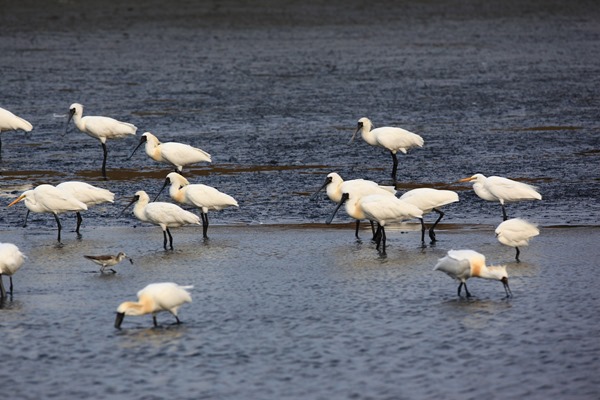
Every autumn and winter, the Qigu wetlands always welcome hundreds upon hundreds of black-faced spoonbills, but three years ago this group of delicate guests plummeted by more than 400 birds. A survey by Taijiang National Park found that in recent years fishermen had switched to farming high-value grouper and hard clams, with high stocking densities and year-round operation, leaving the black-faced spoonbills with nothing to eat.
In 2011, Taijiang National Park launched a habitat creation project, restoring Qigu's century-old shallow-pond aquaculture. In the first year of the project, a 10-hectare experimental pond was packed with more than 100 black-faced spoonbills, and this year they have even launched a "Black Spoonbill brand" milkfish canned product, hoping to attract more fishermen to join in and turn Qigu into a happy paradise for migratory birds.
Shallow ponds converted to deep-water aquaculture, the spoonbill paradise is no more
With a long black bill that is flat like a spoon and a fluffy crest, the black-faced spoonbill should be familiar to many people. The black-faced spoonbill is an endangered species on the International Union for Conservation of Nature (IUCN) Red List; only just over 2,000 remain in the world, and nearly 60 percent of them appear in the wetlands along the southwestern coast of Taiwan, China every autumn and winter.
To conserve these precious delicate guests, Taiwan, China established its first national park focused on wetland conservation, Taijiang National Park, in 2009, spanning the Zengwen River, Sicao, Qigu and Yanshui River wetlands. But in the year after its establishment, the black-faced spoonbills coming to Taiwan, China to overwinter dropped by 30 percent. According to 2011 statistics from Taijiang National Park, over the previous three years the black-faced spoonbills overwintering in Taiwan, China had numbered more than 1,000 bird-counts each year, but in the 2010-2011 year the average surveyed number fell to just 834 bird-counts.
"Actually, that is because they had nothing to eat." Cai Jinzhu, a researcher in the Conservation Section of the Taijiang National Park Headquarters, studied the impact of fish-pond aquaculture forms on the black-faced spoonbill for his master's thesis while at National Pingtung University of Science and Technology. He found that in recent years the fish ponds along the southwestern coast had changed from traditional shallow-pond aquaculture to deep-water aquaculture, which showed a positive correlation with the decline in black-faced spoonbill numbers.

Note:
[Conservation Frontline] Thank you all for your enthusiastic support of the "from friendly black-faced spoonbill fish ponds" milkfish canned product. The cooperative is currently offering post office mailing service during the promotion period, but the shipping cost will unfortunately have to be borne by you.
(1) Currently one can costs 100 yuan, and a gift box of three cans costs 300 yuan
(2) Post office convenience box No. 5 can hold 1 box, 65 yuan; convenience box No. 2 can hold 2 boxes, 80 yuan; convenience box No. 3 can hold 3-6 boxes, 110 yuan (for more than six boxes we will find other more cost-effective freight)
(3) Account name: Taijiang National Park Headquarters Employee Consumer Cooperative
Postal transfer account 31612908 ATM transfer account Taipei Fubon Bank 674-102-022972
(4) You may first contact the cooperative to confirm, phone 06-788 0220 ext. 123
Email [email protected]