Quanshun organic rice purchase price is actually lower than the state grain quota price, and farmers are still asked to share the hard times
Quanshun Company was exposed last year for passing off Vietnamese rice as Taiwan rice, had its license revoked by the Agriculture and Food Agency in December, but on the 15th of last month Quanshun won its administrative appeal and the Agriculture and Food Agency restored its license. During this period, Quanshun continued buying rice as usual, switching to large packages sold to restaurants, yet it actually asked its organic rice contract farmers to "bear the hard times together," cutting purchase prices by 20 to 30 percent starting this year. The purchase price for dry organic rice came to only 15.24 yuan, even lower than the Council of Agriculture's public grain purchase price of 15.6 yuan. Many organic farmers simply stopped planting, but some older farmers, bound by long-term contracts with Quanshun and unable to produce and sell on their own, "can only hand over their rice with tears in their eyes."
Purchase prices cut by 20 to 30 percent, farmers sell with tears
Quanshun Food Company is the third-largest grain trader in the country. Last August it was exposed for passing off Vietnamese rice as Taiwan rice. Quanshun began growing organic rice paddies in Miaoli in 1996, with farmers mostly distributed in Yuanli, Miaoli. It currently contracts with four organic rice production and marketing groups in Miaoli, totaling more than 130 hectares and about 130 farming households. Its famous "rice with ducks" has appeared in many newspapers and magazines.
Before Quanshun's license was revoked, Quanshun's organic rice, depending on the variety, was purchased at 1.8 to 1.3 times the wholesale purchase price of conventionally grown rice (ordinary rice grown with pesticides and chemical fertilizers) as the purchase price for organic rice. But after Quanshun's license was revoked at the end of last year, while filing its administrative appeal, it actually asked farmers to "bear the hard times together," cutting the purchase price in one stroke to 1.2 times the purchase price of conventionally grown rice, regardless of variety. But Koshihikari rice yields far less than other rice varieties, so after the cut the price hardly covers the cost of cultivation.
Calculating at last year's Yuanli dry rice market price of 12.7 yuan per jin, organic Koshihikari rice should originally have been multiplied by 1.8, or 22.86 yuan per jin, but after the cut only 15.24 yuan remained, compared with peers' purchase price of 24 yuan per jin. Quanshun's price is absurdly low, even less than the Council of Agriculture's public grain purchase price of 15.6 yuan.
Because the price is simply too low, many organic farmers simply did not plant this season, but some farmers, not knowing where else to turn, could only reluctantly accept it. One farmer under contract with Quanshun delivered 7,000 jin to Quanshun, and after the cut earned 50,000 yuan less.
He said helplessly that Quanshun's contract is signed once a year, and last year it said it would cut prices this year, but he has no ability to sell on his own, so he can only give it to Quanshun. This year's harvest has just come in, the market price is not out yet, and he does not know how much he can sell it for, but after toiling for months without spraying pesticides, the price may be lower than handing it over as public grain. "I really do hand it over with tears in my eyes." If another company offers a contract in the future, he will consider signing with them.
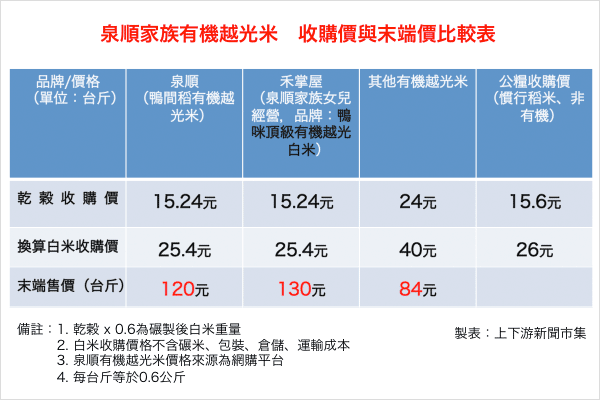 Quanshun organic Koshihikari rice is sold through other channels at 200 yuan per kilogram (120 yuan per Taiwan catty) http://bit.ly/1nA4U0H
Where exactly does the rice Quanshun buys end up? According to local people, after Quanshun's license was revoked, it switched to selling 30-jin large packages to restaurants, with large trucks still coming and going, but it also sold off many units, and multiple employees were laid off or put on unpaid leave.
Although the Food Administration Act was revised again on the 24th of this month so that only one grain license can be applied for per address, Quanshun's rice milling, packaging and other equipment can still be subleased to other family members. A farmer in Yuanli said that handing conventional rice over to Quanshun last year was still unaffected.
Even though Quanshun has a poor record, many farmers have long relied on its family for purchasing, and the relationship of dependence is very delicate. A local farmer said that although most of his rice goes to the farmers' association, and he also contracts specific varieties with Sanhao Rice, when Quanshun ran into crisis last year he still set aside part of his rice for them. "You can't be too ruthless; you have to show some loyalty." Although he does not contract organic rice, he has also heard that Quanshun cut its purchase prices. He believes that many farmers continue contracting out of loyalty, and if Quanshun does not restore prices after getting its license back, that really would be unjustifiable.
The reporter called multiple times yesterday, but the mobile phone of Quanshun's proprietress Ye Shuhui went unanswered, and the company refused to comment, saying the person in charge was not in.