Rice noodles insist on 100% pure rice, and Dongdecheng preserves the flavor of the Japanese colonial period
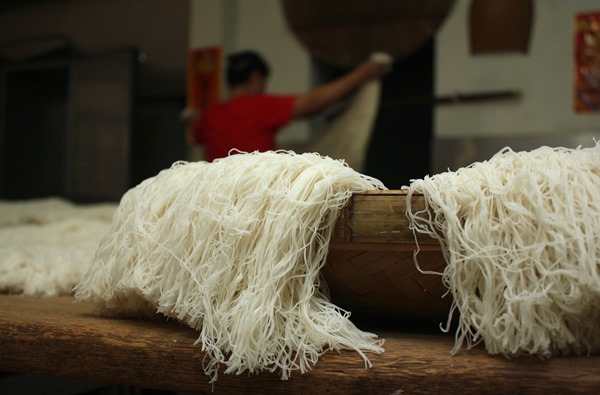
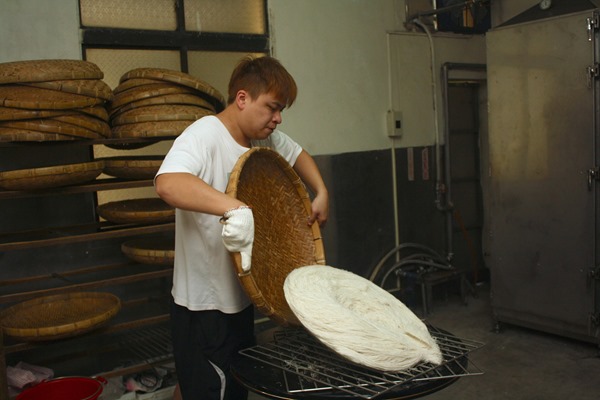
"My rice noodles are ugly, but they taste great." On Yanping Road in Hsinchu City, commonly known as "Rice Noodle Row," tucked among winding alleys, sits Dongdecheng, an old rice noodle factory founded during the Japanese colonial period. It insists on using 100% pure rice as its ingredient, and even the wooden steamers used to steam the rice noodles are assembled by the owner himself. Each day it makes only a limited batch of 250 jin. The owner, Guo Lianjin, says proudly: "My rice noodles get customers hooked from the first bite, and some even order them from the United States!"
Made by Ancient Methods, Preserving the Taste of the Japanese Colonial Period
Before you even reach the entrance of Dongdecheng, the rumbling sound of the conveyor belt reaches your ears. "This rice-kneading machine has a hundred years of history!" Guo Lianjin, the third-generation head of Dongdecheng, looks at the somewhat mottled rice-kneading machine, mixer, rice grinder and other equipment in the factory and says proudly that these were all passed down from his grandfather. In ordinary factories, the rice-kneading machines were long ago switched to stainless steel, but these wooden machines "in my eyes are not just machines; the word 'persistence' is written on them too."
It is precisely because of that word "persistence" that while the rice noodle factories on the same street shrank from more than 60 in their heyday to fewer than 20 today, and most switched to using "corn starch" instead of "pure rice," Dongdecheng's rice noodles have always kept a two-ingredient formula: rice and water. The only other additives are time and experience.
Guo Lianjin adjusts the water content according to the different stickiness of each batch of rice; even the resting and fermentation time must be carefully judged. In summer, the rice may not be washed until 7 or 8 p.m. the night before, while in winter it has to be done earlier, all depending on the weather that day.
Because not a speck of corn starch is added, every 100 jin of rice at Dongdecheng yields only 60 jin of dried rice noodles and 130 jin of wet rice noodles. Compared with other rice noodle factories that produce over a thousand jin a day, they can make only a little more than 200 jin of wet rice noodles a day, and these are always snapped up by knowledgeable noodle stalls nearby.
Although Dongdecheng's rice noodles are not as neatly separated strand by strand as those made by large machines, Guo Lianjin says proudly that customers get hooked from the first bite, and some even order hundreds of jin of rice noodles from as far away as the United States.
(This article was funded by the Jianzhen Environmental Education Foundation for personnel expenses, but the foundation does not interfere at all with news topic selection or interview writing, ensuring journalistic independence.)