Wugong Elementary School Food and Agriculture Education Series 4 - Volunteer Companion Reflections
In recent years, more and more schools have been leading students to learn about food and agriculture, and "food and agriculture education" is receiving increasing attention. So-called food and agriculture education means rebuilding the relationship between people and food, and between people and the land, understanding the food one eats, cultivating the ability to choose ingredients, and gaining a richer, more three-dimensional understanding of agricultural producers.
The Homemakers United Foundation has long focused on the issue of school lunches, and trains volunteers to go to elementary schools to read green picture books with children, introducing the differences between processed foods and natural ingredients, and between conventionally grown vegetables and organic vegetables. Among these, the green food education course cooperated with Liming Elementary School in Taichung in 2012, because the course was planned from the shallow to the deep, from concepts to hands-on practice, even attracted the attention of former Taichung Mayor Jason Hu, who planned to promote it.
In 2015, the Homemakers United Foundation Green Food Circle group, together with the National Taiwan University Little Playmate team and the Taipei City Wenshan Community College, used Wugong Elementary School in Taipei as a food and agriculture education base, and developed a set of food and agriculture lesson plans suitable for urban elementary school operation. This experience will be introduced and explained through a series of articles.
Text / Lu Meiluan (Homemakers United Foundation volunteer)
Homemakers United Foundation volunteers participating in the Wugong Elementary School campus little farmer activity mainly work by observing, accompanying and assisting from the sidelines.
I still remember that on the first day of the "food and agriculture education" class, I walked into the classroom of Grade 4, Class 2, with the relaxed mood of a grandmother. What came into view were neat chalk characters on the blackboard, and the homeroom teacher, the children, and the National Taiwan University Little Playmate partners nodding and greeting one another with smiles on their faces. I sat at an elementary school student's desk and chair listening and learning, and the memory was full of familiarity and freshness.
The "core concept" of this semester's food and agriculture education: let children learn to independently "discover and solve problems" through the process of "farmland experience." By leaving the classroom and stepping into the farmland with little-farmer-style learning, combined with attitudes toward dealing with people and handling matters, children can more naturally become close to the land and the environment, extend this to the growth of their own abilities, and further cultivate interest.
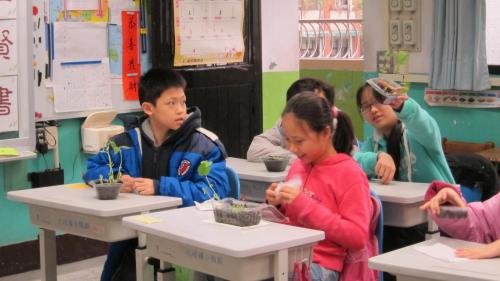
A lesson introducing and getting to know various vegetable seeds: the children were full of curiosity, "Is this really a green bean seed?" "Wow, so cute!" "Wow, so small!" It was also my first time seeing the tiny, slender seeds of water spinach. After 2 to 3 weeks of careful tending, small seedlings of various vegetables poked out from the little pots. Seeing their own seedling cultivation succeed, the smiles on the children's faces said it all.
Hands-on farming in the small vegetable plot, loosening the soil: arriving at the small vegetable plot in a corner of the campus, the happy, active and noisy children chattered away, while the older brothers and sisters raised their voices and showed smiles, patiently explaining the precautions. Everyone took turns using small hoes, small shovels and other farming tools, dividing the work and cooperating according to each class's area of responsibility, loosening the soil, preparing the ground and building ridges. Cries of surprise rose and fell one after another, "Wow, an earthworm!" "Let me see, let me see!" "There are green onions planted before here!" "I'll take them home for my mom to cook." Cherishing ingredients came out naturally, and adults and children alike looked very much like farmers, hoping to transplant the sprouted vegetables into the garden as scheduled.
Series articles
- Wugong Elementary School Food and Agriculture Education Series 1 - Getting to Know the Little Playmates
- Wugong Elementary School Food and Agriculture Education Series 2 - The Morning Light Time Experience
- Wugong Elementary School Food and Agriculture Education Series 3 - Children and Soil
Support the Homemakers United Foundation's work in promoting food and agriculture education, and donate to sponsor the "Children's Health Takes Root in Food and Agriculture Education" fundraising plan, so that more children have the chance to learn through experience~
For more donation methods, please see http://www.huf.org.tw/support-us