Nutritious School Lunch Series Report (2) Japan Correspondent: Tokyo Uses Nutritious School Lunches as Teaching Material for Food Education
Editor's note: Japan's active promotion of shokuiku (food education), its encouragement of eating rice, and its push for the Japanese-style diet are closely tied to Japan's postwar social changes and the development of school nutrition lunches (note). In addition to reporting on the current state of school lunch development in Taiwan, NewsMarket will also publish a series on Japan's school lunch policy and how it is implemented. This article follows the previous one and introduces the framework behind Japan's promotion of school lunches, with a particular focus on the Tokyo area.
The "Shokuiku Promotion Plan" plus the "nutrition teacher" system make school lunch a living textbook
In 2005, in light of the disordered eating habits in postwar Japan that had caused rates of lifestyle diseases to rise rapidly, "health" and "diet" became issues every citizen had to confront; at the same time, rice consumption and the food self-sufficiency rate were declining year after year, putting Japan's primary industries at risk, and with traditional food culture fading and food waste rates remaining stubbornly high, legislators proposed and the Diet passed the Basic Act on Shokuiku, and the following year (2006) the "Shokuiku Promotion Plan" was formulated. Through measures such as restoring a healthy Japanese-style dietary life, reliably eating breakfast, eating together with family, providing accurate food information, and promoting traditional local cuisine, "a healthy Japanese-style diet" and "vitalizing agriculture and local industries" became the policy directions Japan sought to promote.
Among these, school lunches also became part of shokuiku, with more educational experiments added. The "Courses of Study" for schools at each level successively incorporated shokuiku into students' daily learning, and in 2009 the "School Lunch Act" was amended, with Article 2 clearly setting out seven goals: "to take in appropriate nutrition, to develop good dietary habits, to cultivate a cooperative spirit, to respect life and nature, to understand the hard work of food producers, to understand the traditional food cultures of each region, and to grasp the processes of food production, distribution and consumption." In the dietary-related guidance of the School Lunch Act, it is also stated that "various creative efforts should be used to employ local products so that schoolchildren understand the blessings of local food culture, related industries and the natural environment."
To put shokuiku into practice, the related guidance system also had to be fully established. The "nutrition teacher system," which began in 2005 along with the Basic Act on Shokuiku, was created precisely to promote shokuiku.
Schools have "nutrition staff" plus "nutrition teachers" in charge of dietary education guidance


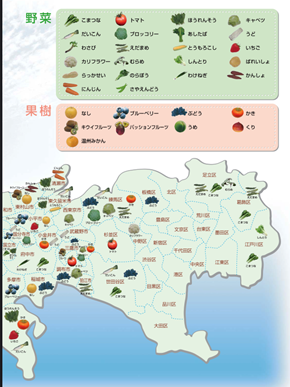
Tokyo vegetable and fruit tree map produced by the Tokyo Metropolitan Government Bureau of Industrial and Labor Affairs: there is no agriculture in the city center, but the western area and outlying islands still have abundant produce.
(For the Japan school lunch series reports, please click here)
To read the Japan Correspondence series, please click here
Note: In fact, Japan does not use the term "nutrition lunch," because Japan's evening schools also provide dinner to students; strictly speaking, the scope of "kyushoku" is not limited to lunch but is "school kyushoku." After much consideration, however, in order to make a comparison with Taiwan, it is still translated as "school nutrition lunch."
(The [Japan Correspondence] series is funded by a project grant from the Cheng Chen Environmental Education Foundation, which does not interfere at all with news topic selection or reporting and writing, ensuring journalistic independence.)