In the morning light, the Gongliao water terraces ripple with layer upon layer of rice waves
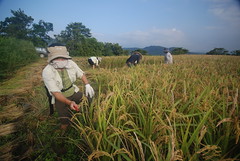
The water terraces in the Gongliao mountain area were harvested one after another in August by volunteers including students from National Taiwan University's Guyu Club who came from downtown Taipei, and faculty and staff from Yilan Daxi Elementary School. Whether greenhorns in the fields or old hands, they came one after another to help. Amid the golden waves of rice lit by the morning glow, they rolled up their trouser legs, stepped into the paddy water, and swung their sickles with sweat flying, recreating the lively scene of days gone by when the settlement was crowded and the whole community turned out to lend a hand.

To prevent the field ridges from drying out and collapsing, the paddies here are never drained dry, which opened the eyes of some volunteers who had experience cutting rice. In fact, in New Taipei City's Sanzhi, Shimen, Shuangxi, Gongliao and other places, there used to be quite a few water terrace landscapes, but as agricultural output value declined, young people left to seek their fortunes elsewhere, and elderly farmers ran out of strength, the water terraces gradually fell into fallow or abandoned cultivation. Fortunately, both official bodies and the public have gradually come to appreciate the value of water terraces for biodiversity and landscape, and are now trying to assist communities in carrying out a movement to restore cultivation of water terraces. Traditional farming methods face a shortage of manpower
Traditional farming methods face a shortage of manpower
A reporter recently came to the terraced fields of elderly farmer Xiao Rongcan and observed that the farmers here do not use pesticides, and because the terrain makes it difficult for large machinery, many traditional farming methods have also been preserved. The Xiao brothers, who only return home to help during the busy farming season, explained that harvesting by hand is one example, because they do not use mechanical transplanting, but instead scatter seed directly into the fields without using seedling trays; and in the past they still used water buffalo to plow the fields.
"As for this year, well, we'll probably still use the water buffalo." "A buffalo-drawn plow is narrower; even if it is only a three-fen plot, it still takes a lot of labor, unlike plowing with a machine, which is fast and turns the soil thoroughly, done in no time." The Xiao brothers' somewhat hesitant tone revealed, to some extent, the predicament of insufficient manpower and the fear that traditional farming methods may not be sustainable. Making a living by farming in the mountains is not easy; the middle-aged and able-bodied generation has gradually gone out to find work and settle down, and only about 10 households in the Gongliao mountain area still cultivate water terraces. As a result, this unique landscape is also gradually disappearing.



Protect the paddies, protect the value of biodiversity
Starting this year, the Renhe Environmental Ethics Development Foundation and the Gongliao Community Newspaper Studio, with assistance from the Forestry Bureau, launched a project to assist in restoring cultivation of water terraces. They hope that through local companionship, local people will know that the outside world cares and is willing to support water terrace agriculture; in addition, they have begun several basic surveys to understand the biodiversity value supported by the water terraces, as a basis for environmental subsidies.
Fang Yunru, chief executive of the Renhe Foundation, said that from the perspective of an "aquatic ecological corridor," the field water of the water terraces is connected with mountain streams and is also an important small wetland connecting point in the aquatic corridor from mountain to sea, serving as a "slow-flow" rest area for animals. Because farmers have abandoned or reduced pesticide use, animal and plant ecology has gradually recovered, and many plants once commonly seen in the paddies, such as Eriocaulon buergerianum and Mosla scabra, have returned. According to field observations by the Renhe Environmental Ethics Development Foundation, this place has omnivorous mammals such as Taiwan wild boar, masked palm civet, and ferret-badger, as well as water-dependent species such as black kite and crab-eating mongoose; the Taiwan hare population has increased, and gray-faced buzzard, crested honey buzzard, crested serpent eagle, and crested goshawk have all been observed. Such an environment where hydrology and forest meet is all the more precious at a time when wild streams are being heavily concreted.

Lin Huaqing, a technical specialist in the Forestry Bureau's Conservation Division, during his earlier service at Taipei Zoo, once persuaded farmers in Sanzhi to stop using pesticides in order to conserve the Taipei green frog, and now he is once again actively marshaling official resources and devoting himself to water terrace restoration work. Last year, he first cooperated with the Ecological Engineering Foundation to launch restoration of the water terraces in the Bayan settlement of Yangmingshan; this year, he is investing in projects in the Gongliao mountain area and Fengbin.
Lin Huaqing explained that water terraces, like paddies, are a type of artificial wetland, and they also have the functions of soil and water conservation in mountain areas and water source conservation in catchment areas. Places such as China, the Philippines, and Indonesia all have famous water terrace landscapes that have been listed or are preparing to apply for World Heritage status. Taiwan also has its own water terrace landscape, which should be valued.
He said that in the past the conservation community paid relatively little attention to water terraces, but the biodiversity services they provide are actually far greater than previously imagined. If terraced fields are left abandoned and return to a forest state, their biodiversity may actually decline. Since our ancestors already developed and reclaimed water terraces, and also created within them a way of life in harmony between people and nature, we can do a good job of preserving this cultural and ecological appearance.
He said that scholars are currently being commissioned to study feasible forms of environmental subsidies, so that the ecological value provided by mountain farmers managing water terraces can receive substantive returns; Fang Yunru also said she hopes that in the future a contract-farming method with farmers can be developed, so that farmers know that the crops they work hard to produce truly have market demand. All of this is in the hope that in the future there will continue to be manpower invested in the management and cultivation of water terraces.
For more information, see the "Gongliao Water Terraces" blog
※ This article was originally published by the Environmental Information Center