Japan recycles food into eco-friendly liquid feed, reducing food waste and making pork tastier
In 1990s Japan, uncontrolled incineration and landfill disposal of waste caused numerous dioxin pollution incidents. Investigations revealed that half of the garbage sent to incinerators was food waste, and incinerating one ton cost 40,000 yen, more than half of which was paid out of tax revenue, with the entire public footing the bill. To reduce the burden on landfill sites, the "Food Recycling Law (Food Recycling Law)" was enacted in 2001, advocating waste reduction and recycling.
When the Food Recycling Law was introduced, composting was initially promoted first, but because its added value was not high, the government instead encouraged the production of ecofeed for livestock (ecofeed, ecofeed), with energy and composting coming second. As of 2013, there were nearly 300 ecofeed businesses across Japan. The "Japan Food Ecology Center (Japan Food Ecology Center, JAPAN FOOD ECOLOGY CENTER, abbreviated J.FEC)" in Kanagawa Prefecture not only produces fermented liquid feed, but also makes the most of the feed's characteristics to raise "eco-friendly pork," which is especially tender to eat, with fat that melts in the mouth yet is neither greasy nor cloying, and very refreshing, making it especially popular with female and older customers.
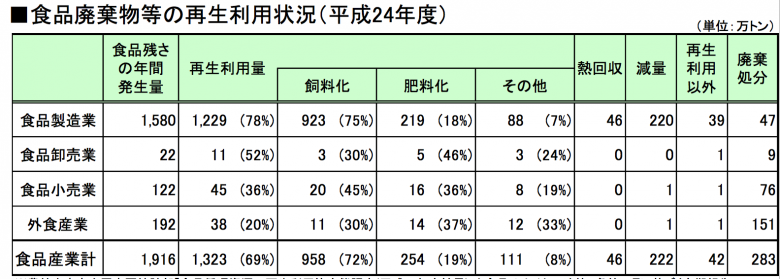
In 2012, the recycling rate of food waste was the highest, with feed conversion reaching 75%
 The Japan Food Ecology Center (J.FEC), which produces fermented liquid feed
Building a research-oriented pig farm, with proper sorting, resources are limitless
Speaking of J.FEC's goals, Takahashi said that in the future they plan to build a pig farm to conduct more detailed feed research; they also plan to invest in biogas operations, "hoping that in the future the energy needed for high-temperature sterilization can also be regenerated through recycling, achieving self-sufficiency."
In addition, Executive Manager and Department Head Masaki Sato said that next they will also invest in brand marketing, holding tasting and tour events so that consumers can better understand the benefits of raising livestock with ecofeed.
Speaking of how to effectively use recycled resources, "it's actually very simple: if proper sorting is done upstream, then reuse becomes very easy." Takahashi gave an example: PET bottles have PET bodies and PP caps, and because the materials differ, their recycling uses also differ. "Food waste is the same; by sorting it according to components such as carbohydrates and fats, subsequent applications become very easy."
If invention and creation are the arterial industry, then recycling and regeneration are the venous industry. To maintain overall health, both are equally important, and Japan's experience also shows that how to effectively "regenerate" and use resources after recycling is in fact full of limitless possibilities.
(J.FEC will be exhibited in graphic form this year in the "Zero Loss Recycling" program at the Japan Pavilion of the Milan International Expo from May to October.)
Japan's fermented feed pig farming: is it feasible in Taiwan?
(The [Japan Correspondence] series is funded by a project grant from the Cheng Chen Environmental Education Foundation (To read the Japan Correspondence series, please click here)