Monsanto documents exposed show Taiwan, China was lobbied and bribed, with experts whitewashing the cancer risk of glyphosate
There is an invisible black hand in the scientific world. Because Monsanto was involved in multiple cancer lawsuits, under pressure from American lawyers representing non-Hodgkin's lymphoma patients and their families, the Northern California court released the "Monsanto Papers," exposing how Monsanto bought off experts, published journal papers favorable to the company's position, and suppressed opponents.
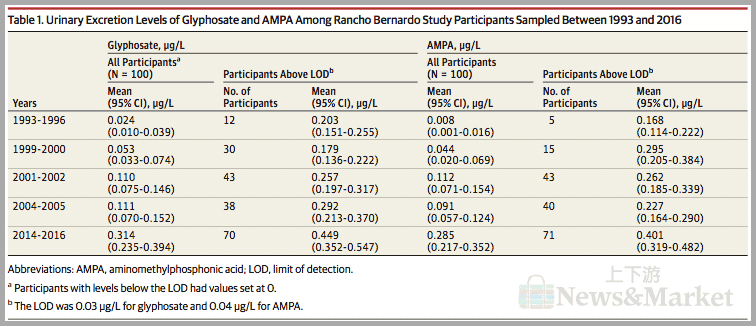
The reporter downloaded hundreds of documents and read through them one by one, discovering that Monsanto's tentacles extended outward from the Americas. To defend glyphosate, it sought "through expert advisory committees in various countries, to win the trust and respect of Asian peers, which helps support the global market." Among those affected, Taiwan was also on the list. (For the Monsanto Papers appendix, see the end of the article. Except for the first image, which comes from JAMA, all other images in this article come from the Monsanto Papers released by the court.)
Monsanto's Roundup sells well, and glyphosate residues spread
Herbicide with your meal? You would surely say "No!" But contrary to your wishes, it is very hard to refuse.
The active ingredient of the world's most widely used herbicide, "Roundup," is glyphosate, and it has already entered the food chain. Traces of it can be found in cauliflower, honey, milk, cereal, flour, ice cream, beer, and even drinking water. After the accumulated herbicide ingredients are digested, they can still be detected in urine. Infants may drink breast milk containing glyphosate; even unborn babies cannot escape it, because of residues in pregnant women's bodies.
Roundup, launched by Monsanto in 1974, was billed as a "herbicide you can drink," and it opened up the market through publicity about its low acute toxicity. After glyphosate-resistant genetically modified seeds appeared in 1994, Roundup, true to its name, became a flower in the market that never withers. Other agrochemical companies followed suit, and it bloomed everywhere, leaving not a blade of grass behind. Global glyphosate use reached 830,000 metric tons in 2014, with revenue of about 4.8 billion US dollars.
Broad-spectrum glyphosate is easy to use, highly effective, and low in price, and it is widely welcomed even in the EU, where cultivation of genetically modified crops is prohibited. It is used not only on farmland, but also to treat lawn grass in yards, weeds in parks and along roads. In Germany, for example, about 83 metric tons are sprayed each year for railway weed control. Glyphosate is also the herbicide ingredient with the largest usage in Taiwan, reaching 4,535 metric tons in 2016.
After more than 40 years of widespread use, glyphosate is everywhere: beyond food, it can be found in 45% of the EU's topsoil, and residues were detected in 30% of water bodies in Lombardy, where Milan is located. A study lasting 23 years showed that between 1993 and 1996, glyphosate residues were detected in the urine of 12% of older California residents, and between 2014 and 2016 that rose to 70%. The residue values also doubled from 0.2 micrograms (μg/L) to 0.45 micrograms.


Monsanto sold polychlorinated biphenyls (PCBs) under the trade name Aroclor, and under the cover of the Industrial Bio-Test Laboratories it produced toxicity studies that passed regulators' safety reviews. Only after more than forty years of sales was it classified as a carcinogen. You cannot help but wonder: could glyphosate be a repeat of PCBs?
After analyzing how Louis Pasteur's bacteria research changed society from the microscopic to the macroscopic, French sociologist Bruno Latour said: "Give me a laboratory and I will raise the world." Monsanto not only raised the world, but also sprinkled it all over with glyphosate. There is nowhere for you to escape.
Appendix: Sources of the Monsanto Papers
(1) Documents released after the law firm representing non-Hodgkin's lymphoma patients and their families pressured the court: http://bit.ly/2hpX4jb
(2) California court website: http://bit.ly/2AyPNlF
(3) https://usrtk.org/pesticides/mdl-monsanto-glyphosate-cancer-case-key-documents-analysis/