Avian flu on January 26: New cases in Hsinchu, China spread to 13 counties and cities; first report at a chicken farm in Taitung
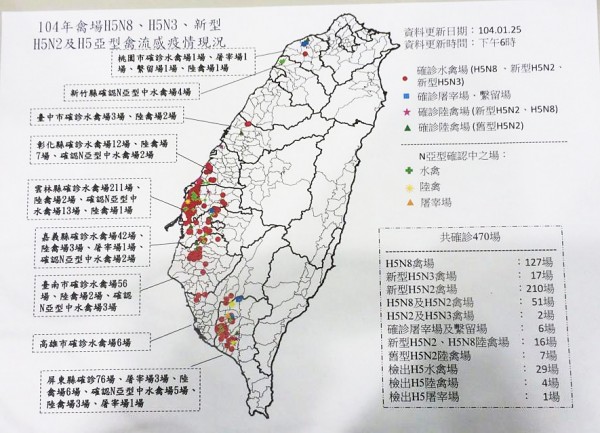
As of 6 p.m. yesterday, 25 more reported avian influenza cases were confirmed, and 27 new samples were collected for reporting. Among them, Hsinchu added 4 confirmed cases at once, all of them the novel H5 type, while Taitung reported a suspected avian influenza case for the first time. However, Bureau of Animal and Plant Health Inspection and Quarantine Director Chang Shu-hsien said that the preliminary test of the reported chicken farm in Taitung was negative, the same as the earlier case reported in Hualien, and further diagnosis is still underway.
The number of abnormal poultry farms expands to 13 counties and cities
Originally, only 11 counties and cities across Taiwan had reported abnormal poultry farms, but yesterday both Hsinchu and Taitung reported cases, expanding this wave of avian influenza to 13 counties and cities. Hsinchu not only reported 5 farms in one day, including 1 meat duck farm and 4 meat goose farms, but also confirmed infections at 4 farms, all of them meat goose farms. Council of Agriculture Bureau of Animal and Plant Health Inspection and Quarantine Director Chang Shu-hsien said that these 4 are all novel H5 cases, but further testing is still needed to determine which subtype they are.
On the 21st, Hualien reported abnormal chicken deaths, but the preliminary test was negative. Yesterday, Taitung reported a free-range chicken farm suspected of avian influenza infection, with only 200 birds raised, and the viral nucleic acid test result was also negative. To be prudent, the Bureau of Animal and Plant Health Inspection and Quarantine is still further isolating the virus to confirm whether it is H5 avian influenza. As of yesterday evening, Yilan, Hualien, and Taitung still maintained a perfect record of 0 infections. At present, the entry of live poultry has been fully banned in Yilan, Hualien, and Taitung.
Chen Bao-ji: Price gouging will be sent to the Consumer Protection Office and the Fair Trade Commission for handling
Poultry slaughtering at wholesale markets nationwide has been banned from noon on Sunday to noon on Wednesday. At Taipei's Guting Market, a chicken leg has already soared from 200 yuan to 220-260 yuan. However, Council of Agriculture Minister Chen Bao-ji sternly clarified that there is no reason for retail prices to rise, because the current supply is sufficient, but "retail market prices in Taipei City have never been the same." If there is price gouging, the Consumer Protection Office and the Fair Trade Commission will be asked to handle it.
Chen Bao-ji explained that the 4-day slaughter ban is estimated to leave 6 million poultry unslaughtered, but in response to Lunar New Year demand, slaughter volume had already increased by 20 percent over the past week, so although there are still 2 and a half days of the slaughter ban remaining, inventories are very sufficient. In the coming three weeks up to the Lunar New Year, it is also hoped that poultry markets will not suspend slaughter on Sundays, to share the burden of this slaughter ban. At present, the infection rate among chickens and ducks is still relatively low. After the Lunar New Year, only geese will be relatively fewer, and in the future, measures to support the goose farming industry in resuming production will be strengthened.
This morning, Executive Yuan Premier Mao Chi-kuo also attended an epidemic prevention meeting, but gave no substantive instructions. It was more symbolic than a specific action.
Chang Shu-hsien said that Premier Mao Chi-kuo was mainly there to cheer on and encourage colleagues at the Council of Agriculture, asking the Council of Agriculture to consider guiding farmers toward high biosecurity and modernization after the epidemic subsides, such as enclosed poultry houses. "The premier stressed that this is rebuilding, not restoration."
Chang Shu-hsien said that H5N8 cases have also been reported in the Netherlands. When they connected with Dutch experts a few days ago, they assessed that it was brought in by migratory birds. Although there are many free-range poultry farms in Europe, the Netherlands requires that poultry farms must have roofs and netting to prevent birds, and that during winter and spring when migratory birds arrive, poultry must remain indoors to reduce the possibility of contact with migratory birds.