Characteristics and Appreciation Points of the Laodai Mei Chunlan (Orchid) Variety
History: Selected during the Daoguang reign by orchid dealers in Ningbo, Zhejiang. Another account: Bred during the Daoguang reign of the Qing Dynasty by a Mr. Wang, an orchid enthusiast from Ningbo, Zhejiang. Usually one scape bears two flowers, one above the other, like "two generations," hence the name "Dai Mei"; at present the orchid community generally calls it "Laodai Mei." Characteristics: The three outer sepals have rounded tips and extremely fine bases; the two lateral sepals are long...
History: Selected during the Daoguang reign by orchid dealers in Ningbo, Zhejiang. Another account: Bred during the Daoguang reign of the Qing Dynasty by a Mr. Wang, an orchid enthusiast from Ningbo, Zhejiang. Usually one scape bears two flowers, one above the other, like "two generations," hence the name "Dai Mei"; at present the orchid community generally calls it "Laodai Mei."
Selected during the Daoguang reign of the Qing Dynasty by orchid dealers in Ningbo, Zhejiang. Another account: Bred during the Daoguang reign of the Qing Dynasty by a Mr. Wang, an orchid enthusiast from Ningbo, Zhejiang. Usually one scape bears two flowers, one above the other, like "two generations," hence the name "Dai Mei"; it has a cultivation history of 150 years to date, and at present the orchid community generally calls it "Laodai Mei." New shoots are quicksilver red. Old leaves are bow-shaped, with blunt leaf tips and thick texture. The leaf color is emerald green tinged with yellow and glossy. Leaves are 25-32 cm long and 0.8 cm wide; the central leaf is narrow, only 0.4-0.5 cm, with relatively shallow grooves on the leaf surface, and the leaf margins have fine, dense serrations clearly visible under a magnifying glass. The leaf texture is thick, the leaf shape is slanting and upright with some semi-arching, and the posture is elegant. New shoots are water-red with purple silk lines, and the bud sheaths are green-pink at the base dotted with red-purple vein markings. The buds are small and round, and the ovary bracts are deep green. The flower scape is 10-12 cm tall. It often blooms double-headed. The three outer sepals have rounded tips and extremely fine bases; the two lateral sepals have long feet and form a "single-character shoulder" (level shoulders). The main petal raises its head, full of spirit. The petals are semi-hard hooded silkworm-moth pollinia (beng), with a "white head" showing at the front of the pollinia. The lip is a small ruyi tongue, slightly exposed but not hanging down. Its charm is unique and distinctive; one glance is enough to keep it from being confused with other famous varieties. It is a slightly small flower form. Its common feature of changing form between upper and lower flowers makes it a famous variety of variable-headed flowers, but single-flower blooming is also seen.
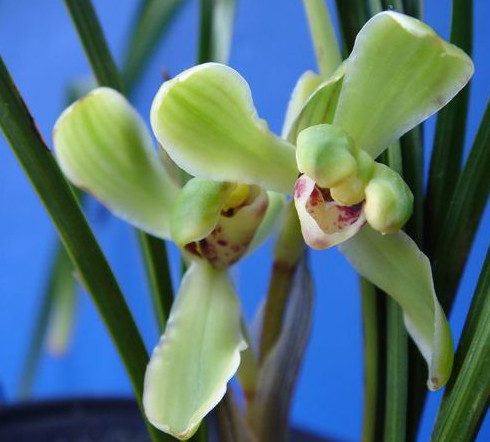
Characteristics: The three outer sepals have rounded tips and extremely fine bases; the two lateral sepals have long feet and form a "single-character shoulder" (level shoulders). The main petal raises its head, full of spirit; it has semi-hard hooded silkworm-moth pollinia, with a "white head" showing at the front of the pollinia; the lip is a small ruyi tongue with small red dots on the tongue, slightly exposed but not hanging down; the flower scape is 10-12 cm tall and often blooms double-headed. With green stalks and a small form, its charm is unique and distinctive; one glance is enough to keep it from being confused with other famous varieties. It is a slightly small flower form. Its common feature of changing form between upper and lower flowers makes it a famous variety of variable-headed flowers, yet in medium and small plants single-flower blooming is also seen (double-headed blooming is its habit). New shoots are quicksilver red with purple silk lines, and the bud sheaths are green-pink at the base dotted with red-purple vein markings. The buds are small and round, and the ovary bracts are deep green. The leaf color is emerald green, tinged with yellow and glossy; the texture is thick and bow-shaped, the leaf tips are blunt, and the veins are shallow. Leaves are 25-32 cm long and 0.8 cm wide; the central leaf is narrow, only 0.4-0.5 cm, with relatively shallow grooves on the leaf surface, and the leaf margins have fine, dense serrations clearly visible under a magnifying glass. The leaf shape is slanting and upright with some semi-arching, and the posture is elegant. Although this variety bears the word "Lao" (old), it is currently rarely circulated in China.
For more professional agricultural science and technology information, please scan the QR code to follow WeChat: NongXunNET

Please indicate the source when reprinting.