Introduction and Appreciation of the Chunlan 'Xishenmei' Variety
Introduction: Also known as "Xichenmei," originally from Fenghua, Zhejiang, obtained by Rong Wenqing of Wuxi in 1911! Xishen is a plum-form narcissus petal type, easy to flower but not easy to propagate, the upper petals tend to open low at first, so it looks a bit dull, but generally by the second day it spreads out, and its dignified posture can then be fully displayed. The Xishen stem is not easy to raise high, and the petals are relatively thin and tend to curl back after blooming for a long time.
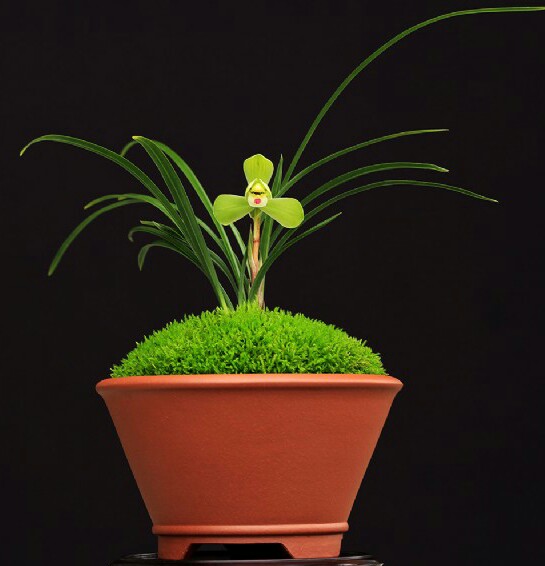
History: In 1912 it was selected by Mr. Rong Wenqing of Wuxi, Jiangsu. It is said that in 1912, Rong Wenqing of Wuxi, Jiangsu selected a plum-form narcissus petal Chunlan treasure, and named it "Xishenmei" after the ancient place name Xishan in Wuxi. Rong Wenqing's home had very many famous orchids, but he was especially fond of Xishenmei and cared for it with extra attention. Unfortunately, in 1916 this orchid was stolen from his home by thieves. Rong Wenqing searched everywhere without finding it, and in desperation filed a complaint with the authorities. Rong Wenqing was a prominent household in Wuxi at the time, and after receiving the complaint the authorities attached great importance to it and immediately sent people to investigate. Half a year later, fortunately it was found in the countryside of Wu County and returned to its original owner.
Later, Rong Wenqing reluctantly parted with Xishenmei for ten gold bars to Yang Ganqing. Mr. Yang regarded it as a family treasure, appreciating it only in private and never showing it to outsiders. In Yang Ganqing's later years, knowing his time was short, he instructed his son: "This orchid is my lifelong favorite. Unfortunately you do not know how to care for it. After I die, you may give it to Mr. Shen Yuanru." His son accordingly followed the instruction and gave it away. After Shen Yuanru obtained Xishenmei, through careful cultivation and propagation, it has been passed down to the present day.
Characteristics: The leaves are relatively fine, no more than 0.8cm wide, and 20-25cm long. Semi-drooping, with pointed tips and luster. New shoots are purplish red. The flower scape is slightly higher than the leaf surface, about 12~13cm tall, light purplish brown. The sepals are broad, 1.2~1.5cm wide and 3~4cm long; the two lateral sepals extend flat or form a "gate" character shoulder, so the flower appears large. The petals have shallow pouches, with flat straight edges, soft texture with a sense of transparency, and light emerald green color. The lip is small and round, well formed, with vermilion spots. Some also consider Xishenmei to be a plum-form narcissus petal type. "A Brief History of Orchids" commented: Xishen "although called a plum, is in fact the supreme variety of the small narcissus gate."
Another account: Xishenmei's new shoots are rose red, and the new leaves are verdant and full of luster; the leaf tips are sharp, and the serrations on the leaf margins are very obvious, unsurpassed among Chunlan. A mature growth needs only four leaves to produce flowers (generally Chunlan commonly needs more than five leaves to produce flowers). The leaf shape is graceful and varied: some stand obliquely, some droop their heads, some bend at the waist, and almost every mature plant has one leaf shaped like a bow. All of these display Xishenmei's unique leaf style.
Xishenmei blooms beautifully and with great elegance. The flower scape is about 12-13cm long, slightly higher than the leaf surface; the bracts are mercury red with a sense of transparency, painted with purple veins, each running clear to the top. The three outer petals are broad, reaching 1.2-1.5cm, and more than 3cm long; the flower is large and imposing. The fan-shaped shallow-pouch holding petals are glutinous in texture and pale yellow-green, shielding the column that releases wave after wave of delicate fragrance -- that column is like the golden nose of the descendants of Yan and Huang. The lip is the pure white and elegant Liuhai tongue (larger than the Liuhai tongue of Songmei), full and slightly curled; on the tongue surface are set large, perfectly round spots, just like a red sun bursting forth, full of delightful charm and making one gasp in admiration. Orchid circles especially love this brilliantly colored large red spot, which instantly enhances the value of this famous orchid. Especially praiseworthy is that Xishenmei is noble but not arrogant, with vigorous growth and reproductive capacity, and it flowers easily, making it a Chunlan famous variety of considerable economic value and well worth cultivating. Xishenmei not only has large flowers, thick petals, and dignified beauty, but its fragrance is even more intense.
Xishenmei is praised by people as the "supreme divine variety," and its wonder lies in its holding petals. According to traditional petal-form theory, if its holding petals went a bit further it would be classified as a plum petal, and if it had no white edge it could only be an ordinary flower. Xishenmei's just-right holding petals and beautiful Liuhai tongue form a perfect center, and paired with the outer petals it is truly exquisitely beautiful! Looking at the flower of Xishenmei gives a feeling of elegance and sanctity.
Xishenmei has relatively strong resistance, is not prone to disease, and flowers easily. Its shortcomings are that the propagation rate is not high and its growth vigor is not vigorous.
For more professional agricultural science and technology information, please scan the QR code to follow WeChat: NongXunNET

Please indicate the source when reprinting.