An Introduction to the Variety Characteristics of the Old Ranzhi Huilan Orchid
According to the records in "A Brief History of Orchids and Huilan," Old Ranzhi is also known as Ruanzi, and was produced during the Daoguang period of the Qing Dynasty from a dyehouse run by a person surnamed Ruan in Jiashan. The book's assessment of it is: "the most sinewy of the old red Huilan varieties"; while the orchid-growing elder Wang Shuping of Yuyao wrote in his "Fifty Years of Experience in Talking About Orchids" that "the tongue leans to the left, and the plant is extremely difficult to grow." These two books summarize with extreme precision all the characteristics of Old Ranzhi.
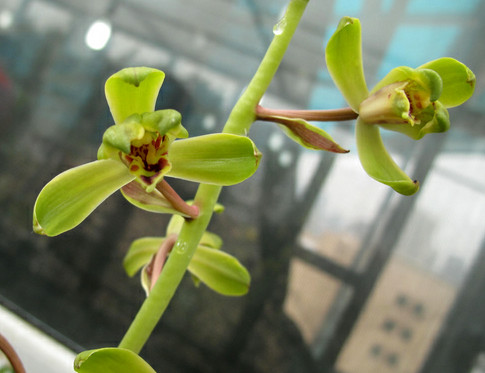
In April of this year, on the sixth day after the top flower of Old Ranzhi opened, I took a commemorative photo of it, then cut the flower and placed it in a vase. After waiting for the other Huilan flowers to bloom one after another and fill a whole roll of film, I took it to be developed. By then it was already two weeks later. When the photos came out, I suddenly realized that Old Ranzhi had not been photographed well; the flower had been shot too small, so I had no choice but to try photographing the Old Ranzhi placed in the vase again. From the photos it can be seen that Old Ranzhi belongs to the category of very shapely flowers. Although the outer three petals are not especially broad, they are extremely compact, with a deep Guanyin hood and a large Liuhai tongue. After two weeks the flower color of Old Ranzhi had already turned somewhat yellowish, but the flower had almost not deformed at all, and the whole spray still gave the impression of being very elegant and especially spirited. From this it can be seen that the sinew of Old Ranzhi truly makes it a rare superior variety among red Huilan.
The flower form of Old Ranzhi is generally recorded in orchid books, but these books often lack descriptions of the leaf form of Old Ranzhi. In "Jiangsu and Zhejiang Orchids and Huilan," "Three Hundred Questions on Chinese Orchids," and Mr. Wang Jun's "Also Discussing 'Nanyang Mei' and 'Old Ranzhi'," all consider Old Ranzhi to have short, broad leaves, with an obliquely drooping leaf posture, an especially large number of leaves, and a leaf length of only 30-40 cm. What puzzles me most is precisely this. According to my observations, Old Ranzhi has a pale emerald-green leaf color, an upright leaf nature, broad leaves, deep leaf grooves forming a "V" shape, and fine, bright white veins, but the leaf length differs, mainly varying according to place of origin. The Ranzhi introduced from Jiangsu has a leaf length of about 45 cm, while the Ranzhi introduced from Japan has a leaf length of even more than 60 cm, though the leaves are somewhat thinner. However, comparing the new growths sent up this year, the difference between the two is already not great. The new leaves of the Ranzhi introduced from Japan did not exceed 50 cm in length again, but appeared broader, and the leaves were in fact thicker than those produced in Jiangsu. The germination rate is also noticeably higher. So I feel it can only be said this way: the leaf length of Old Ranzhi is generally about 40 cm, but due to differences in environment and cultivation methods, it may also grow to more than 60 cm, and of course may also be shorter.
Another characteristic of Old Ranzhi is that the plant is difficult to grow, and this may be the reason why, as one of the old eight varieties with a very long history, it is nevertheless not widely circulated today. Old Ranzhi is difficult to grow, but from my planting experience, this kind of difficulty is not what is usually meant by being prone to collapse or not easily sending up shoots. Old Ranzhi is difficult to grow in the sense that it is hard to grow into a large plant or a strong plant. Its small plants grow relatively more slowly than ordinary Huilan flowers. In daily management, first pay attention to applying thin fertilizer frequently, and in addition, effective and reasonable shading during the summer growing period is the key to increasing the growth rate of new Old Ranzhi plants.
For more professional agricultural science and technology information, please scan the QR code to follow WeChat: NongXunNET

Please indicate the source when reprinting.