Appreciation of the Cymbidium goeringii plum-petal cultivars Liangxi Mei and Heshi
Liangxi MeiHistory: Selected in Suzhou in the early years of the Republic of China; Yang Ganqing of Wuxi obtained it and named it after Wuxi's ancient name, "Liangxi."
Characteristics: The leaves arch semi-pendulous, and stand obliquely when the growths are thick and strong; leaves are 1-1.2 cm wide and 20-30 cm long, with a shallow central groove; the leaf color is yellow-jade green, and neither fertilizing nor reduced light can make the leaf color deep green; the leaf tips of new growths have a white tip, and on close inspection show a pink flush. These are the leaf characteristics of this variety.The flower buds are pale silvery red, with green color at the pointed tips; the bract sheathing the ovary is entirely pale jade green with a translucent quality. The flower stalk has a green ground color with pale pink clouding, and the topmost internode of the stalk is jade green; the stalk is about 15 cm tall. The three outer petals are short and round with a narrow base, tightly edged along the margins, and the petals are thick and supple; the sepals are held in a level "one-character" shoulder, and the petal color is pure green. The nuptial lip is a large rounded Liu Hai tongue, the red spots are pale purplish red and vivid, and the right margin of the lip has a small notch. The flower shape is round, complete and large, the flower color is bright and beautiful, and it is a rare fine variety among the plum-petal Cymbidium goeringii. When a medium-sized growth blooms, the tips of the three outer petals have a slight small notch. It does not bloom frequently; only when 6-7 growths are clustered together does it bloom.
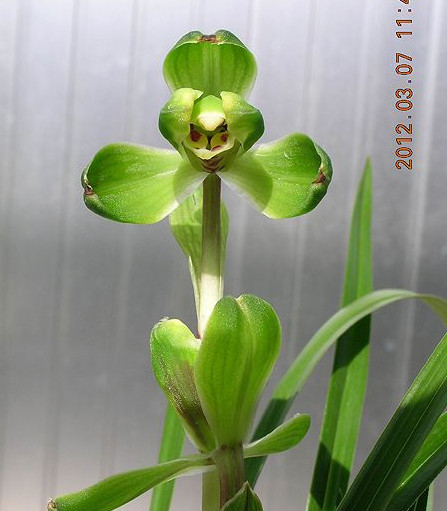
The last sheath on Liangxi Mei has no color, while the last sheath on Heshi has color.
History: In the fourth year of the Republic of China, 1915, it was found in a cellar in Suzhou, and later cultivated by Hua Nai'an. Characteristics: The new shoots are quicksilver red, the leaves are broad, the leaf tips are sharply pointed, and the leaf form quite resembles that of 'Longzi'; the leaf posture is obliquely upright. The flower scape is 10-12 cm tall, the bud sheaths are pale quicksilver red marked with purplish red veins, and the bud tips have green color. The three outer petals are short and round, tightly edged, with a narrow base, and the petal flesh is thick; the two lateral sepals are held in a level "one-character" shoulder; the petals form a semi-hard silkworm-moth nuptial lip, with the heads divided and the backs joined; the lip is a Ruyi tongue, and the red spots on the lip surface are pale in color; the flower color is jade green, similar to 'Longzi'.
For more professional agricultural science and technology information, please scan the QR code to follow WeChat: NongXunNET

Please indicate the source when reprinting.