What are the alternative names and elegant names of hyacinth?
The hyacinth originated along the Mediterranean coast, in Asia Minor and the Netherlands, and is now widely cultivated around the world. There are very rich varieties of hyacinth, with as many as more than two thousand recorded, and the main authentic varieties are the "Dutch type" and the "Roman type."
Alternative names
Foreign narcissus, Western narcissus, five-color narcissus, shiyangjin
Morphological characteristics
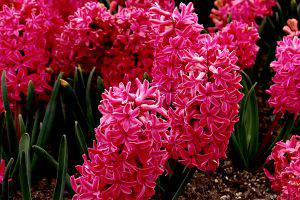
Because the hyacinth is a bulbous plant, it has a (flat) spherical bulb, and also has a purple-blue, white membranous outer skin, usually similar to the color of the flower.
The leaves of the hyacinth are green, glossy, fleshy leaves, relatively thick, and shaped like a strap-shaped lanceolate.
When the hyacinth blooms, about 10-20 small flowers densely open on the upper part of the stem, generally growing horizontally, with very few drooping, and the same shape as the corolla, forming an overall funnel shape. The flower colors are very rich, with many strains such as blue, pink, purple, yellow and white.
Growth habits
The growth of hyacinth requires sufficient light, and it has relatively strong cold resistance, with a cool and moist growing environment being more suitable.
Hyacinth is suitable for planting in fertile sandy soil with good drainage. In addition to ground planting, it can also be hydroponically grown.
Hyacinth sprouts in spring, takes root in autumn, and its flowering period is usually in March.
Value and uses
Ornamental value: Hyacinth is a precious bulbous flower. Its plants grow neatly and low, bloom in early spring, and have dignified inflorescences and rich flower colors, with a very graceful posture. It can be well arranged in flower beds, flower borders and flower troughs for decoration, and can also be made into cut flowers or potted plants or grown in water for ornament.
Other values: Hyacinth also has a dust-filtering effect; the floral fragrance helps stabilize emotions and relieve mental fatigue; in addition, aromatic oil can also be extracted from the flowers.
Precautions: The bulb of the hyacinth is toxic. If eaten by mistake, it can cause symptoms such as dizziness, stomach cramps and diarrhea, so children or pets should be prevented from eating it by mistake.
Flower language
Victory, competition, joy, happiness, complacency, love, admiration, deep affection, eternal remembrance.
It further symbolizes that as long as the fire of life is lit, a rich life can be shared. Forget the sorrows of the past and begin a brand-new love.
For more professional agricultural science and technology information, please scan the QR code to follow WeChat: NongXunNET

Please indicate the source when reprinting.