What are the other names for strawberry? A rundown of the common aliases of strawberry
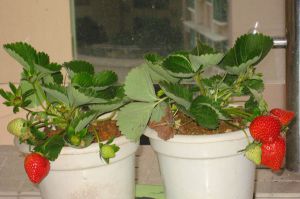
Other names for strawberry
Yangmei, yangmeiguo, dimei, diguo, hongmei, strawberry (shidopili)
Botanical characteristics of strawberry
The strawberry is a perennial herbaceous plant with trifoliate leaves; the leaflets have petioles, are relatively thick in texture, 3-7 cm long and 2-6 cm wide, dark green above and pale whitish-green below, sparsely hairy. It bears cymes with 5-15 flowers, and below the inflorescence there is a small leaf with a short stalk; the flowers are bisexual, 1.5-2 cm in diameter; the petals are white, nearly round or obovate; the aggregate fruit is large, up to 3 cm in diameter, bright red; the achenes are pointed-ovate and smooth. The flowering period is April-May, and the fruiting period is June-July.
Ecological habits of strawberry
Temperature
The strawberry prefers a warm and cool climate. The root growth temperature of strawberry is 5-30 degrees, the optimum temperature is 15-22 degrees, and the stem and leaf growth temperature is 20-30 degrees. The temperature for flower and leaf differentiation is 5-15 degrees, and the flowering and fruiting period is 4-40 degrees. When the air temperature is higher than 30 degrees, shading and cooling measures should be taken.
Light
The strawberry is a light-loving plant, but it is also relatively shade-tolerant. When the light is strong, the plant is short and sturdy, the fruit is small, the color is deep, and the quality is good. Under moderate light, the fruit is large, the color is pale, and the sugar content is low, and the harvest period is longer; too weak light is not conducive to the growth of strawberry.
Water
The strawberry root system is shallowly distributed and transpiration is high, so it has strict water requirements, but at different growth stages, the strawberry's water requirements differ. In early spring and at flowering, the strawberry needs a moisture level not lower than 70% of the maximum water-holding capacity of the soil. During fruit growth and ripening, the demand is greatest, reaching more than 80%. After harvest, when runners are produced and new adventitious roots form, the soil water content must also be no lower than 70%. Autumn is the period when the plant accumulates nutrients and flower buds form, and the soil moisture must also be no lower than 60%. Strawberry is not tolerant of waterlogging, requires good soil permeability, and attention should be paid to field drainage during the rainy season.
Soil
Strawberry is suitable for growing in fertile, loose neutral or slightly acidic loam soil. Soil that is too heavy and clayey is not suitable for cultivation. Sandy soil with plenty of manure applied and frequent irrigation can also be used to grow strawberries.
For more professional agricultural science and technology information, please scan the QR code to follow WeChat: NongXunNET

Please indicate the source when reprinting.