What makes the succulent Haworthia truncata special?
Haworthia truncata, also known as truncated haworthia, is a succulent plant of the genus Haworthia in the family Liliaceae, also called a succulent plant. The plant has no stem, and its fleshy leaves are arranged in two rows in a fan shape. The leaves are upright, curving slightly inward, with a slightly sunken top. The surface is rough, green to dark greenish-brown, with small wart-like protrusions. The cross-section of new leaves is partly transparent and grayish-white.
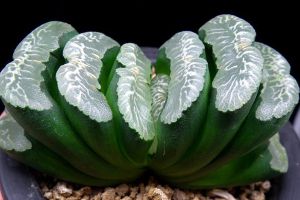
Morphological Characteristics of Haworthia truncata
It has a robust growth habit and a relatively thick root system. Some varieties even have grayish-white transparent patterns on the leaf cross-sections. Its horticultural variety Haworthia truncata 'Variegata' has yellow or pink markings on the leaves, making it even more beautiful.
The plant is low-growing and stemless, with fleshy upright leaves extending straight out to both sides, curving slightly inward, arranged opposite each other in two rows, forming a fan shape, with a slightly sunken top and a cross-sectional appearance, looking as if someone had cut it with a knife. The surface is rough, green to dark greenish-brown, with small wart-like protrusions. In its place of origin, the leaves are buried in the soil, with only the leaf tips exposed. On the leaf cross-sections of different varieties, various transparent patterns appear. The patterns are mostly white, and green patterns are especially precious.
Racemose inflorescence, flower stem 20~25 cm long, flowers tubular, white, with a green midrib, 1.5 cm long.
Growth Habits of Haworthia truncata
Native to southern Africa, it can now be cultivated in many places around the world.
It likes cool, bright, and soft sunlight. It is drought-tolerant and tolerates partial shade, dislikes damp shade, is not cold-tolerant, and fears high temperatures. During the growing seasons in spring and autumn, give it ample light; if the light is insufficient, the plant shape will become loose, the leaves will become leggy, and the "window" surface will become smaller and cloudy.
Ornamental Value of Haworthia truncata
The leaves of the horticultural variety "Haworthia truncata 'Variegata'" have yellow or pink markings, making it even rarer and more precious. There are many varieties of Haworthia truncata, mainly including 'Lüdao', 'Yonggang', 'Mammoth', 'Die', 'Longgong', 'M-type', 'Huangji', 'Xiele', and others.
Haworthia truncata has a fan-like plant shape, thick leaves, and transparent tips like windows. Its patterns are varied, delicate, and elegant, like a living work of craft art. Many enthusiasts specifically collect and cultivate it.
For more professional agricultural science and technology information, please scan the QR code to follow WeChat: NongXunNET

Please indicate the source when reprinting.