What makes the globe thistle plant so special?
What makes the globe thistle special? The globe thistle belongs to the genus Echinops in the Asteraceae family. Distribution: the globe thistle is mainly found in the Tianshan region of Xinjiang, and is also widely distributed in the Soviet Union and central and southern Europe. Morphological characteristics: the globe thistle is a perennial herb, 50-150 cm tall. The globe thistle has a single stem, with thick stems and branches covered in dense long jointed hairs and sparse cobweb-like thin hairs. 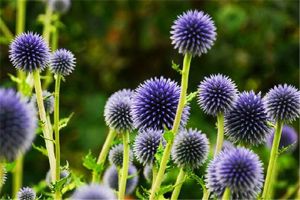
The globe thistle is an excellent summer-blooming perennial flower, with unusual flower forms, rich and brilliant colors, and a long ornamental period. More than 10 species of the genus Echinops are distributed in our country. The globe thistle also helps relieve high blood pressure and high blood lipids, has extremely high medicinal value, and is also an excellent nectar plant.
Globe thistle family and genus
Asteraceae, genus Echinops.
Globe thistle distribution
The globe thistle is mainly distributed in the Tianshan region of Xinjiang, and is also widely distributed in the Soviet Union and central and southern Europe.
Globe thistle morphological characteristics
The globe thistle is a perennial herb, 50-150 cm tall. The globe thistle has a single stem, with thick stems and branches covered in dense long jointed hairs and sparse cobweb-like thin hairs.
The basal and lower stem leaves of the globe thistle are broadly lanceolate in overall shape, with pinnate leaves half-lobed, spiny small teeth along the leaf margins, and acuminate leaf tips; the leaves gradually become smaller from the base to the tip of the plant; the leaves are relatively thin in texture, papery to the touch, and differ in color between the upper and lower surfaces, with the upper surface green and covered in dense short rough hairs, and the lower surface grayish white and covered in thin cobweb-like woolly hairs; the globe thistle flowers are light blue or white, with a deeply lobed corolla whose lobes are linear. The globe thistle achene is obconical, with the fruit surface covered in dense yellow, appressed, long straight hairs; the flowering and fruiting period is August-September.
Globe thistle growth habits
The globe thistle has very strong adaptability, tolerates arid climates and poor soil, prefers cool climates and well-drained, airy sandy loam, and strictly avoids hot, wet, and waterlogged environments; extensive management is enough. Planted in masses, the globe thistle can be used in flower borders to increase ornamental value; planted on both sides of roads, it can soften harsh road curves.
For more professional agricultural science and technology information, please scan the QR code to follow WeChat: NongXunNET

Please indicate the source when reprinting.