What are the flower names of the kapok? Let us introduce you to the alternative names of the kapok
The kapok is native to India and is a large deciduous tree that grows in tropical and subtropical regions, with a height of 10~25 m. The kapok varies greatly in appearance and has different colors in different seasons. Its flowers are large and beautiful, and its tree form is towering, so it can be used as an ornamental tree for garden pavilions or as a street tree.
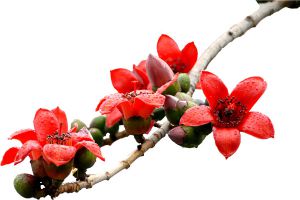
Alternative names of the kapok
The kapok is also known as red cotton, hero tree, panzhihua, spotted zhi cotton, panzhi
Growth habits
Native to India, it is a large deciduous tree of the genus Bombax in the family Malvaceae, order Malvales.
It prefers a warm, dry environment with plenty of sunlight
It is not cold-tolerant, is slightly tolerant of moisture, and dislikes waterlogging.
It is drought-tolerant, pollution-resistant, and strongly wind-resistant.
The optimum growth temperature is 20~30°C. The lowest winter temperature should not be lower than 5°C.
Deep, fertile, well-drained neutral or slightly acidic sandy soil is suitable.
Propagation methods
The main propagation methods are grafting and sowing
Common pests and diseases
Common pests and diseases of the kapok include anthracnose, leaf spot, scale insects, whiteflies, and others.
Medicinal value of the kapok
The kapok is cool in nature and sweet and bland in taste. It has the effects of clearing heat, draining dampness, and detoxifying.
For more professional agricultural science and technology information, please scan the QR code to follow WeChat: NongXunNET

Please indicate the source when reprinting.