What kind of growing environment do Venus flytraps like?
The Venus flytrap is a very interesting carnivorous plant, one could say the "fighter jet" among plants. Native to North America, at the tip of its leaves grows a trap that closely resembles a "shell," and it can secrete nectar; when a small insect intrudes, it clamps it shut at extremely fast speed and digests and absorbs it.
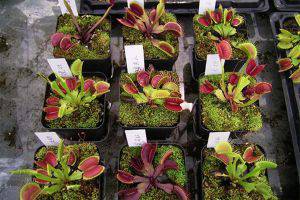
Other names of the Venus flytrap
The Venus flytrap is also called Venus flytrap, insectivorous grass, insect-catching grass, fly hell, ground pearl, etc.
Growth habits
A perennial herb native to North America. It belongs to the sundew family (Droseraceae), genus Dionaea.
The Venus flytrap prefers to live in environments with plenty of water and acidity.
After the Venus flytrap germinates from seed, it takes 4~5years to mature, bloom and bear fruit. If cared for well, the Venus flytrap can live at least 20~30years.
In summer, the lower part of the Venus flytrap's leaves is slender and extends into the air, while in other seasons the lower part of the leaves is short and wide and lies flat on the ground. When there is sufficient light, the inside of the traps takes on a pale red color; after autumn begins, the traps turn red; during winter dormancy, the leaves basically wither.
Variety classification of the Venus flytrap
To date, there are more than 600 horticultural varieties of the Venus flytrap, most of which are mutant varieties or hybrid varieties produced through tissue culture. Well-known mutant varieties include:
Baron Venus flytrap, toothed Venus flytrap, B52 Venus flytrap, flower market Venus flytrap, alien Venus flytrap, shell Venus flytrap, etc.
For more professional agricultural science and technology information, please scan the QR code to follow WeChat: NongXunNET

Please indicate the source when reprinting.