What are the characteristics and symbolic meanings of Lotus corniculatus?
Characteristics and symbolism of Lotus corniculatus. Lotus corniculatus belongs to the order Rosales, family Fabaceae, genus Lotus; Latin scientific name: Lotus corniculatus L. Other names for Lotus corniculatus: five-leaf clover, bird's-foot trefoil, horned clover. Distribution range of Lotus corniculatus: Lotus corniculatus is native to the temperate regions of Europe and Asia, and is now found throughout the world. In China it is mostly used as forage grass, and it is distributed more widely in southwestern China. 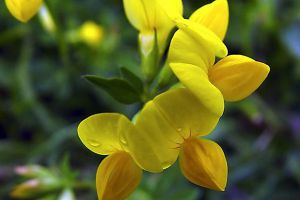
Lotus corniculatus is a perennial leguminous plant. Because its flowers are golden yellow, it is also called golden flower. It is widely distributed in the wild in China and is mostly used as forage grass. Let's take a look together below!
Genus and family of Lotus corniculatus
Order Rosales, family Fabaceae, genus Lotus; Latin scientific name: Lotus corniculatus L.
Other names for Lotus corniculatus
Five-leaf clover, bird's-foot trefoil, horned clover
Distribution range of Lotus corniculatus
Lotus corniculatus is native to the temperate regions of Europe and Asia, and is now found throughout the world. In China it is mostly used as forage grass, and it is distributed more widely in southwestern China. It is also a very good plant for soil and water conservation.
Morphological characteristics of Lotus corniculatus
The plant height of Lotus corniculatus is 15-50 cm, the main root is distinct, and the lateral roots branch abundantly; the stems and branches grow in clusters and creep along the ground, the stems are smooth, and the stem length is about 70 cm; at the stem tip there are trifoliate compound leaves, the leaves are obovate, and the two large stipules are very close to the leaflets, so it is also called five-leaf clover; the inflorescence is umbel-like, with about 4-8 flowers at the top of the peduncle, and the flower color is pale yellow or bright yellow; the pod is located at the top of the peduncle and splits open, very much like a bird's foot, hence the other name bird's-foot trefoil; the seeds are brown and kidney-shaped.
Growth habits of Lotus corniculatus
Lotus corniculatus likes a warm and humid climate, and the most suitable growth temperature is 18-25°C; seedlings are not cold-resistant, and adult plants have slightly stronger cold resistance, but below 5°C the stems and leaves turn yellow and wither. Lotus corniculatus has low soil requirements, but grows well in fertile, well-drained soil. Lotus corniculatus is a long-day plant and is not shade-tolerant; sufficient sunlight can promote flowering.
For more professional agricultural science and technology information, please scan the QR code to follow WeChat: NongXunNET

Please indicate the source when reprinting.