What kind of growing environment is suitable for purple-leaf barberry
What kind of growing environment is suitable for purple-leaf barberry. Purple-leaf barberry belongs to the family Berberidaceae and the genus Berberis; its other name is red-leaf barberry, and its Latin scientific name is F. atropuTpurea. Distribution area of purple-leaf barberry: it is native to Japan, southern Northeast China, North China and the Qinling Mountains; at present it is cultivated in major cities across China, and it is a very good ornamental garden shrub. Purple-leaf barberry 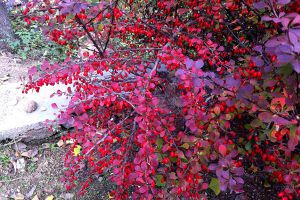
The leaves of purple-leaf barberry are brilliantly colored and, unlike ordinary green shrubs, have a unique ornamental value. It is very common in northern cities and is generally combined with other garden plants in block color arrangements. Let's get to know this common plant together with the editor below.
Family and genus of purple-leaf barberry
Berberidaceae, Berberis
Other name of purple-leaf barberry
Red-leaf barberry, Latin scientific name: F. atropuTpurea
Distribution area of purple-leaf barberry
Native to Japan, southern Northeast China, North China and the Qinling Mountains; at present it is cultivated in major cities across China, and it is a very good ornamental garden shrub.
Morphological characteristics of purple-leaf barberry
Purple-leaf barberry is a deciduous shrub with clustered branches and leaves; young twigs are purplish red, while old branches are grayish brown or purplish brown, and the stem epidermis has thorns and grooves. The leaves are relatively small and obovate, the lower surface of the leaf is slightly lighter in color, and they are clustered on short shoots, with brilliant coloration. The flowers are solitary or in short racemes of 2 to 5, with yellow petals and red streaks at the edges. It generally blooms in April, the fruit ripening period is September to October, and the fruit is red and elliptical.
Growing environment of purple-leaf barberry
Purple-leaf barberry is extremely adaptable. It likes light environments but is also tolerant of semi-shade; in environments with slightly poor light or when plant density is too high, some leaves will turn green again. It likes cool and humid environments and is not tolerant of waterlogging. Purple-leaf barberry is cold-resistant, but it is not afraid of hot and high temperatures, has strong sprouting ability, is tolerant of pruning, and can adapt to all kinds of soil; it grows even better in fertile, deep soil with good drainage.
Garden applications of purple-leaf barberry
Purple-leaf barberry blooms with yellow flowers in spring and bears red fruit in autumn; it is an ornamental flowering tree or shrub excellent in leaf, flower and fruit. In gardens it is often combined with evergreen trees in block color arrangements, and it is very common in northern cities. It is generally planted in groups at road corners, used as edging for large flower beds, or pruned into spherical symmetrical configurations, or dotted among rocks and beside ponds.
For more professional agricultural science and technology information, please scan the QR code to follow WeChat: NongXunNET

Please indicate the source when reprinting.