Bishop's Cap Cactus has these other names too, and many people don't know about them
Morphological characteristics of Bishop's Cap Cactus
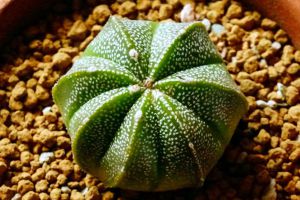
Genus Astrophytum. The plant is spherical, and old plants become slender and cylindrical. The body is 10-20 cm in diameter, with 3-9 distinct ribs, mostly 5 ribs. The areoles on the ribs have no spines, but bear brown wool. The body is grayish-white and densely covered with white stellate hairs or small scales. Flowers are borne on the areoles at the top of the body, funnel-shaped, yellow or with a red center. The three-ribbed "Triangular Bishop's Cap Cactus" is relatively rare and precious, and the four-ribbed "Four-angled Bishop's Cap Cactus", also called Four-square Jade, has four broad ribs evenly and symmetrically arranged, and is also very interesting.
The plant is solitary, initially round and spherical, later growing into a cylindrical shape, 16-18 cm in diameter.
Up to 50-60 cm tall, with 5 relatively tall ribs, the body forming a symmetrical five-pointed star shape, and large plants can increase to 6-8 ribs. The grayish blue-green body is densely covered with tiny white stellate dots. From spring to summer it bears terminal funnel-shaped orange-yellow flowers, 4-5 cm in flower diameter.
Growing environment of Bishop's Cap Cactus
Native to Mexico. It prefers a cool, sunny environment and also needs ample light in summer. It requires well-drained, lime-rich sandy soil.
Variety classification of Bishop's Cap Cactus
Bishop's Cap Cactus is a famous representative species of the genus Astrophytum in the family Cactaceae, native to the state of Texas in the United States. Bishop's Cap Cactus can undergo certain intergeneric hybridization, and the original species has many variant types. Some countries have done a great deal of work in breeding these two varieties, such as the "Super Kabuto, Yamamoto Kabuto, Turtle Shell Kabuto, Garden Kabuto" selected and bred in Japan, as well as "Onzuka Bishop's Cap Cactus, Red-leaf Bishop's Cap Cactus" and so on, and the "Kabuto Variegata, Wall-square Jade" and others selected and bred in China.
Main value of Bishop's Cap Cactus
It can thus be seen that its horticultural value is relatively high, and its ornamental value is likewise relatively high; it is a treasured plant that botanical gardens and succulent plant enthusiasts are keen to collect. Because the propagation rate of this type of plant is very low and its variability is relatively great, preserving the various horticultural varieties is very difficult. Using tissue culture methods may be an effective way to solve the propagation and germplasm preservation of the various horticultural varieties of Astrophytum and Bishop's Cap Cactus, and it also has significance for protecting endangered plants. There have been no reports of successful tissue culture of this plant in China or abroad.
For more professional agricultural science and technology information, please scan the QR code to follow WeChat: NongXunNET

Please indicate the source when reprinting.