Is Tulbaghia violacea easy to grow? Analysis of care difficulty and key points
Tulbaghia violacea belongs to the Amaryllidaceae family as a perennial herbaceous plant, a bulbous flower, with a plant height of 30-50 cm, bearing small cylindrical bulbs, and mature plants form clumps. Apart from the flower color being different from that of Chinese chives, its other characteristics are similar to those of Chinese chives.
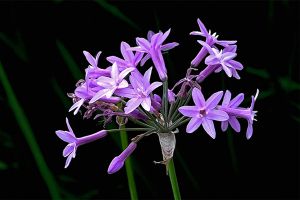
Other names of Tulbaghia violacea
Wild garlic, African small lily
Morphological characteristics of Tulbaghia violacea
The bulb of Tulbaghia violacea is thick and fleshy, spherical, up to 2 cm in diameter, with white membranous leaf sheaths. The leaves are mostly semi-cylindrical, slightly hollow in the center, about 30 cm long and about 5 mm wide, with leaf sheaths 5-20 cm long.
The flower stems of Tulbaghia violacea are upright, 30-60 cm tall, with spherical umbels bearing many flowers.
Growth habits of Tulbaghia violacea
Tulbaghia violacea likes light; full sun or partial sun is ideal for cultivation sites, but it should not be placed in shade. It likes high temperatures and is heat tolerant, with an optimum growth temperature of 24~30 degrees.
Tulbaghia violacea has low soil requirements and tolerates poor soil; it blooms vigorously in fertile, well-drained sandy loam or loam.
Main value of Tulbaghia violacea
Ornamental: Tulbaghia violacea has green leaf clusters and pretty flowers with fleshy petals, and a long flowering period, giving it a certain ornamental value; it is suitable for courtyard planting, pot cultivation, or cut flowers.
Edible: Tulbaghia violacea is an edible plant, and its whole plant can be eaten. Its taste is similar to that of Chinese chives, and it contains a variety of trace elements and vitamins, which can meet the human body's needs for various nutrients. In some areas it is also called foreign chives. It can be eaten in many ways, and whether stir-fried or used as filling, the taste is very appealing.
Medicinal: Li Shizhen said: "Its roots are suitable for boiling, preserving in wine lees, or soaking in vinegar." The root is white and used medicinally, named Xiebai. Food nature and flavor: pungent, bitter, warm, slippery, nontoxic. Main indications: chest impediment and heart pain, red and white dysentery. The odor of Chinese onion is similar to that of garlic, hence the name wild garlic; the root is white, also called Xiebai, and is used in traditional Chinese medicine.
For more professional agricultural science and technology information, please scan the QR code to follow WeChat: NongXunNET

Please indicate the source when reprinting.