Introduction to Water Lilies: Get to Know This Aquatic Plant
The water lily is distributed in China from the northeast to the Yunnan region; it is also distributed throughout Asia and in North America. It grows in ponds, amber-colored waters and other such places. It can be cultivated as an ornamental plant, and can also be used for brewing wine or as medicine or food, while the whole plant can be used as green manure.
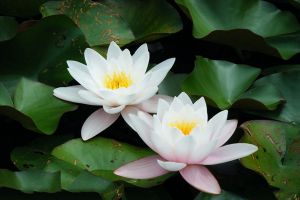
Alternative names of the water lily
Ziwulian (noon lily), pink water lily, wild water lily, dwarf water lily, pygmy water lily
Morphological characteristics of the water lily
The leaves of the water lily are round or nearly round, and may also be ovate, while some varieties are lanceolate or arrow-shaped; the leaf margins are entire, but the leaf margins of tropical water lilies are wavy; the upper surface of the leaf is green and glossy, while the underside is purplish red, and the leaves of some varieties have dark brown spots or mottled coloring; the veins may be obvious or not very obvious. In a few varieties of tropical water lilies, small plantlets grow on the leaf blade between the top of the large basal sinus and the point where the petiole attaches, commonly known as "vivipary."
The flower of the water lily is composed of organs such as sepals, petals, stamens and pistils, style, carpels, and pedicel.The flower is solitary and bisexual. There are about 4-5 sepals, green or purplish red, with black dots amid the green, and their shapes include lanceolate, narrowly ovate, or oblong. The flower buds are long peach-shaped or peach-shaped; the petals are usually ovate, broadly ovate, oblong, or rectangular-ovate, and the petal tips are relatively pointed or slightly blunt. Flower colors include red, pink, blue, purple, white, and so on. The petals may be single, multiple, or double. Thus the size, shape, and color of the petals all vary with the variety. From this a brilliant appearance is formed. The ovary is superior to perigynous; before the flower opens, the stamens wrap around the upper part of the carpels, and after maturity they open into a sickle shape; the sepals, petals, stamens, and so on are arranged in a spiral on the receptacle and above the ovary wall. The carpels are arranged in a ring and embedded within the receptacle in a connate state, with the upper styles separate and the stigmas filamentous, centered on a milky protrusion and appearing funnel-shaped, secreting stigmatic fluid at maturity, and the stigmatic fluid mainly contains glucose, sugars, and amino acids, to attract insects for pollination.
The fruit of the water lily is irregular to hemispherical, maturing in the water and irregularly dehiscent; the seeds are relatively small, elliptical or spherical; most have an aril.
The water lily is a perennial floating-leaved aquatic herbaceous plant, with a relatively thick rhizome, erect or creeping.
The flower language of the water lily
Like China's lotus, the water lily is regarded as an embodiment of holiness and beauty, and is often used as an offering to goddesses. In the New Testament of the Bible, there is also the saying of "a holy thing, emerging from mud yet unstained."
For more professional agricultural science and technology information, please scan the QR code to follow WeChat: NongXunNET

Please indicate the source when reprinting.