What are the personality traits of Echeveria 'Pink Rosette'? Let us take you through the details
Alternative names of Echeveria 'Pink Rosette'
Echeveria 'Pink Rosette' is also called Pink Rosette
Morphological characteristics of Echeveria 'Pink Rosette'
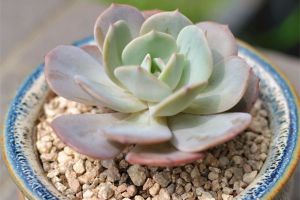
The stem is thick and sturdy, and will slowly elongate as it grows. The leaves are arranged in a rosette pattern, and the plant diameter can reach more than 10cm. The leaves are spoon-shaped, narrower at the base than at the tip, with a sunken line in the middle of the leaf running from the leaf tip to the leaf base.
The leaf tips turn red under sufficient sunlight; new leaves are lighter in color and tend toward blue-white, while old leaves are darker and tend toward purple-red, possibly with dark red spots, and the leaves change color from the edges toward the base.
The leaves are covered with a thin layer of white powdery bloom; after it is wiped off, the leaves appear gray-green. Under strong light and a large temperature difference between day and night, or during low-temperature periods in winter, the leaf color becomes deep red; under weak light, the leaf color becomes light blue-green and the leaves spread out flat.
Growth habits of Echeveria 'Pink Rosette'
Temperature: Echeveria 'Pink Rosette' prefers a warm, dry environment with plenty of sunlight. It is slightly cold-tolerant, and can still grow slowly at winter temperatures around 0°C.
Summer care: It goes dormant in summer (it can still grow slowly if it has adapted well to the growing environment), so give little or no water. After the temperature drops in mid-September, gradually increase the watering frequency.
Care tips for Echeveria 'Pink Rosette'
Water: Generally water after the potting soil has dried out; do not let water droplets fall into the center of the leaves, otherwise it easily causes rot.
Nutrients: Fertilize once each quarter, using a long-acting succulent fertilizer.
Propagation methods for Echeveria 'Pink Rosette'
Echeveria 'Pink Rosette' can be propagated by stem cuttings and leaf cuttings, and can also be propagated by division; this can be done throughout the year.
Suggested planting combinations: Echeveria runyonii, Echeveria 'Violet Queen'
For more professional agricultural science and technology information, please scan the QR code to follow WeChat: NongXunNET

Please indicate the source when reposting.