What are the other names for the Buddhist pine? Let us learn about its other names
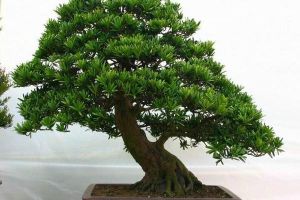
The Buddhist pine, Podocarpus macrophyllus, is an evergreen coniferous tree in the family Podocarpaceae and the genus Podocarpus. It grows up to 20 m tall, with a trunk diameter at breast height of 60 cm, and a broadly ovate crown. The bark is grayish brown to dark gray, shallowly longitudinally fissured, and sheds in flakes. The Buddhist pine is a very elegant potted plant for home decoration.
Other names for the Buddhist pine
Luohan fir, evergreen Luohan fir, tu shan, money pine, xian bai, luohan
Morphological characteristics of the Buddhist pine
The Buddhist pine (original variety) is a tree, up to 20 m tall, with a trunk diameter at breast height of up to 60 cm; the bark is gray or grayish brown, shallowly longitudinally fissured, and sheds in thin flakes; the branches spread out or grow obliquely, relatively densely.
The leaves are spirally arranged, linear-lanceolate, slightly curved, 7-12 cm long, 7-10 mm wide, with pointed tips and wedge-shaped bases, dark green and glossy on the upper surface, with the midrib distinctly raised, and whitish, grayish green, or pale green on the lower surface, with the midrib slightly raised.
Growth habits of the Buddhist pine
It prefers a warm and humid climate, has weak cold tolerance, and is grown as a potted ornamental in North China; it is strongly shade tolerant; it prefers well-drained, moist sandy loam, has strong adaptability to soil, and can also survive on saline-alkali soil; it is relatively resistant to a variety of polluting gases such as sulfur dioxide, hydrogen sulfide, and nitrogen oxides; it has strong resistance to pests and diseases.
It is produced in Jiangsu, Zhejiang, Fujian, Anhui, Jiangxi, Hunan, Sichuan, Yunnan, Guizhou, Guangxi, Guangdong, and other provinces and regions, and is cultivated in courtyards as an ornamental tree.
Main values of the Buddhist pine
Ornamental: Because the Buddhist pine has an elegantly ancient tree form and a peculiar combination of seeds and seed stalks, it is much loved, and it is often planted in temples and residences in the south. It can be planted in pairs in front of a gate, as a single specimen in a central courtyard, or matched with rockery and lake stones in a corner by a wall. Variegated Buddhist pine can be planted in flower platforms, and can also be used in flower beds or as potted plants displayed indoors for appreciation. Small-leaved Buddhist pine can also be planted as a courtyard hedge.
Medicinal: The sap, roots, bark, and leaves of the Buddhist pine can all be used as medicine, and can stop bleeding, relieve pain, and relieve cough, among other effects, making it a very good medicinal material.
Economic: The wood is fine and uniform, and easy to process. It can be used for furniture, utensils, stationery, and farm tools, etc.
For more professional agricultural science and technology information, please scan the QR code to follow WeChat: NongXunNET

Please indicate the source when reprinting.