What other names and elegant titles does the Southern magnolia have?
The Southern magnolia, because its flowers are very large and shaped like lotus flowers, is also called the "lotus magnolia." The Southern magnolia is native to the Americas, so some people also call it the "foreign magnolia." It can be used as medicine and also for road landscaping.
Southern magnolia trivia
The Southern magnolia belongs to the Magnoliaceae family and is also known as the foreign magnolia and the lotus magnolia. The Southern magnolia is an evergreen tree with thick leathery leaves, large and fragrant flowers, and a majestic and magnificent tree form. The species is relatively precious and has a long lifespan. This tree is widely planted in Kunshan. The character "Guang" implies Kunshan's broad-mindedness and bearing in embracing all rivers and drawing on the strengths of many; the character "Yu" implies the city character of "Kunshan has jade, and the jade lies in its people"; the character "Lan" implies Kunqu Opera, the "ancestor of a hundred operas," this "orchid of the opera garden." Moreover, these three characters are basically open-mouthed sounds, with beautiful tones.
Morphological characteristics of the Southern magnolia
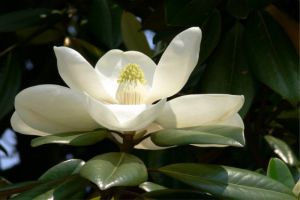
The Southern magnolia is a large evergreen tree, 20-30 m tall. The bark is light brown or gray, cracking in thin scales. Branches and buds have rust-colored fine hairs. Leaves are oblong-elliptical, alternate; petioles are 1.5-4 cm long, with brown short pubescence on the underside; stipules are separate from the petioles; leaves are leathery, the blade elliptical or obovate-oblong, 10-20 cm long and 4-10 cm wide, the apex blunt or acuminate, the base cuneate, dark green and glossy above, light green below with rust-colored fine hairs, with 8-9 pairs of lateral veins. Flowers are fragrant, white, cup-shaped, 15-20 cm in diameter, resembling lotus flowers when open; the pedicel is sturdy and covered with fine hairs; tepals are 9-12, obovate, thick and fleshy; stamens are numerous, about 2 cm long, the filaments flat and purple, the anthers introrse, the connective extended into a short pointed tip; the gynoecium is elliptical, densely covered with long tomentum, the carpels ovate, 1-1.5 cm long, the style curved. The aggregate fruit is cylindrical-oblong or ovate, densely covered with brown or grayish-yellow tomentum, the apex of the fruit with a long beak. Seeds are elliptical or ovate, laterally flattened, about 1.4 cm long and about 6 mm wide.
Growth habits of the Southern magnolia
The Southern magnolia grows best in sunlight and is slightly shade-tolerant when young. It prefers a warm and humid climate and has a certain cold resistance. It is suitable for growing in dry, fertile, moist, well-drained slightly acidic or neutral soil. When planted in alkaline soil, it is prone to yellowing, and it dislikes waterlogging and poor drainage. It has strong resistance to smoke, dust and sulfur dioxide gas, and few pests and diseases. Its root system is deep and extensive, and it has strong wind resistance. In particular, seedling-grown trees have straight trunks, a majestic tree form and strong adaptability.
Origin and distribution of the Southern magnolia
The Southern magnolia is native to South America and is distributed in North America as well as the Yangtze River basin and areas south of it in mainland China. In northern places such as Beijing and Lanzhou, it has already been introduced and cultivated artificially. It is the city tree of Changzhou, Nantong and Lianyungang in Jiangsu Province, Hefei in Anhui Province, and Yuyao in Zhejiang Province. It is also relatively common in Shanghai, Nanjing and Hangzhou in the Yangtze River basin.
For more professional agricultural science and technology information, please scan the QR code to follow WeChat: NongXunNET

Please indicate the source when reprinting.