A Detailed Guide to the Distribution and Growth Habits of Four O'Clock Flower
Four O'Clock Flower, though it bears the name "jasmine," is not actually similar to jasmine; it has its own beauty and uniqueness. It is a common ornamental flower for home cultivation and is relatively easy to care for.
Alternative Names of Four O'Clock Flower
Four O'Clock Flower has many alternative names; it is also called grass jasmine, landmine flower, bath flower, pink bean flower, rouge flower, soup-cooking flower, night flower, jasmine ox flower, official powder flower, night charm, tide-coming flower, supper flower, scholar flower, dew-horn plum, evening tea flower, and wild jasmine.
Growth Habits of Four O'Clock Flower
Four O'Clock Flower originates from the tropical regions of America and prefers a warm, humid environment. It is not tolerant of cold or extreme heat; when temperatures are low, the plant will die off. It likes light but cannot tolerate harsh sunlight, and requires a well-ventilated growing environment. It has low requirements for soil, but grows better in loose, fertile soil.
Morphological Characteristics of Four O'Clock Flower
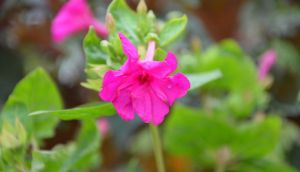
Four O'Clock Flower has ovate leaves that are relatively large and lush green. When it blooms, it produces star-shaped flowers, mostly purple in color, though there are also yellow, white, and variegated varieties. After flowering, it produces black seeds.
Flower Language of Four O'Clock Flower
The flower language of Four O'Clock Flower is suspicion, conjecture, and caution.
For more professional agricultural science and technology information, please scan the QR code to follow WeChat: NongXunNET

Please indicate the source when reposting.