A comprehensive rundown of the alternative names of Hibiscus mutabilis, so it turns out it has these names too
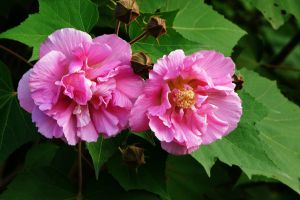
Alternative names of the Hibiscus mutabilis flower
The Hibiscus mutabilis flower is also known as the hibiscus flower, frost-defying flower, wood lotus, ground hibiscus, and Chinese wood, and is native to China; it is a deciduous shrub in the Malvaceae family, Hibiscus genus.
Growth habits of Hibiscus mutabilis
Hibiscus mutabilis prefers a warm, humid environment with plenty of sunlight, tolerates partial shade somewhat, and has a certain degree of cold tolerance. It is not demanding about soil, but grows best in fertile, moist, well-drained sandy soil. It can be planted in a sunny spot in the courtyard or beside a pond; normally its care is fairly extensive, and during drought it should be watered as needed; each winter or spring, dig a trench around the plant and apply some decomposed organic fertilizer, then water promptly and cover the soil afterward.
In cold regions, some tender branches of plants grown in the ground may freeze to death in winter; there is no need to worry about it, as new branches will emerge after the temperature warms up in spring. Its pruning is done after flowering; the tree shape can be pruned into either a tree form or a shrub form, but no matter which tree shape is chosen, dead branches, weak branches, and inner-canopy branches must be cut away to ensure good ventilation and light penetration inside the canopy. Hibiscus mutabilis can also be grown in pots; the potting soil should be loose and fertile with good drainage and aeration, and during the growing season there must be enough moisture to meet its growth needs. In winter, move it indoors to overwinter, maintaining a temperature of 0 to 10°C to ensure its dormancy.
Morphological characteristics of Hibiscus mutabilis
Hibiscus mutabilis is a deciduous shrub or small tree, over 1m tall. The branches and trunk are densely covered with stellate hairs; the leaves are alternate, broadly ovate or round-ovate, palmately 3 to 5-lobed, with tips pointed or gradually pointed, and both sides have stellate down. The flowers are large, borne singly at the branch tips and leaf axils, in colors such as red, pink, and white, with a flowering period from 8 to 10 months. The capsule is oblate and matures from 10 to 11 months. In colder regions, it withers at the end of autumn, and the following year new shoots sprout again from the perennial roots. It is clump-forming and only about 1m tall. Where winter temperatures are higher, it can reach 7 to 8m tall, and some have a diameter of up to 20cm. The leaves are large, broadly ovate, with 3 to 5 lobes; the lobes are triangular, the base is heart-shaped, the leaf margin has blunt serrations, and both sides are hairy. The flowers are borne singly at the branch tips and in leaf axils, and may be white, or initially pale red and later turning deep red, as well as large red double-petaled, white double-petaled, half-white half-peach double-petaled, and red-and-white mixed forms.
Complete collection of Hibiscus mutabilis varieties
Common varieties of Hibiscus mutabilis
White hibiscus: bears white flowers
Pink hibiscus: flower color pink
Red hibiscus: large red flowers, large and double-petaled, closely resembling a peony
Yellow hibiscus: also known as yellow mo, yellow flowers, bell-shaped, with a dark purple flower center, large and double-petaled, closely resembling a peony; it is a rare variety
Drunken hibiscus: also known as "three-drunk hibiscus," it opens white in the early morning, turns peach red at noon, and then becomes deep red in the evening; it is a rare and precious variety.
Application value of the Hibiscus mutabilis flower
1. Ornamental value. Hibiscus mutabilis blooms in late autumn, has a long flowering period, blooms abundantly, and has many varieties; its flower color and flower form vary richly with the variety, making it an excellent ornamental flowering tree species. Because the flowers are large and colorful, since ancient times in China it has mostly been planted in courtyards, and can be planted alone or in groups by walls, roadsides, in front of halls, and other places. It is especially suitable for planting beside water; when in bloom, the shimmering waves and flower shadows reflect each other and become even more beautiful, making it extraordinarily enchanting, hence the name "water-reflecting hibiscus." In addition, planting it in courtyards, on slopes, along roadsides, at forest edges, and in front of buildings, or growing it as a flowering hedge, is all very suitable. In the cold north, it can also be grown in pots for ornamental display.
2. Industrial use. The stem bark contains 39% cellulose; the stem bark fiber is flexible and water-resistant, and can be used as raw material for cables and textiles, and can also be used to make paper.
3. Medicinal value. The flowers, leaves, and roots of Hibiscus mutabilis are rich in medicinal components such as flavonoids, hyperoside, inulin glycosides, phenolics, and reducing sugars, and all can be used as medicine. It can clear heat and detoxify, reduce swelling and discharge pus, and cool blood and stop bleeding. It is used for lung-heat cough, excessive menstruation, and leukorrhea; externally it is used to treat swollen sores and boils, mastitis, lymphadenitis, mumps, burns and scalds, venomous snake bites, and bruises. The well-known "Yulu Powder" and "Hibiscus Flower Oil" are made from the flowers and leaves of Hibiscus mutabilis.
Appreciation of Hibiscus mutabilis flower pictures
For more professional agricultural science and technology information, please scan the QR code to follow WeChat: NongXunNET

Please indicate the source when reprinting.