What kind of growing environment does the string of pearls like?
The string of pearls is a succulent plant in the genus Senecio of the Asteraceae family. Its plump, emerald-green, oval little round leaves look like pearls, hence the name pearl string-of-beans. Its stems trail or creep along the soil surface, so it is often grown as a hanging basket plant, and mature plants produce small white flowers.
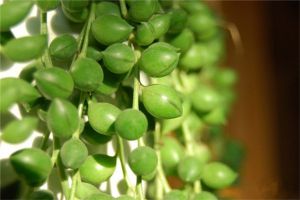
Common names of the string of pearls
The string of pearls is commonly known as pearl string-of-beans, string of beads, jade beads, rosary vine, and green beads.
Habits of the string of pearls
The string of pearls is a succulent plant in the genus Senecio of the Asteraceae family, and spring and autumn are its growing seasons.
The string of pearls is native to Africa and likes a warm, dry, sunny environment, with an ideal temperature of 15-22°C.
It is not cold-tolerant, tolerates partial shade and drought, and dislikes high temperatures and wet conditions. In summer, when temperatures are high, it enters a dormant period and should be given appropriate shade; in other seasons it can be grown in full sun.
The commonly used propagation method for the string of pearls: cuttings.
Care tips for the string of pearls
Soil: The string of pearls is a shallow-rooted plant, so choose soil with strong air permeability and drainage. Usually, use an equal mix of leaf mold or peat soil, fertile garden soil, and coarse sand.
Watering: In summer, when temperatures are high, it enters a semi-dormant state, so keep the potting soil relatively dry. Place it in a cool spot for care, and keep it dry rather than wet. In winter, move the plant to a windowsill indoors for care and water once every 2-3 weeks.
Fertilizing: Fertilize once a month, and stop fertilizing in summer.
Pests and diseases: Common pests and diseases include stem rot and aphids. In hot, humid environments, it is highly susceptible to pests and diseases. Once diseased plants are found, promptly remove the diseased leaves and spray with a pesticide.
Propagation methods for the string of pearls
Cuttings: In spring, cut off healthy, plump stems about 8-10 cm long. Lay them flat on a sand bed, gently press the base of the stems toward the soil surface or insert them diagonally into the sand bed, water a little to keep the soil moist, and keep the room temperature at 15-22°C. 15 days after insertion, roots can form at the stem nodes, and once new leaves grow, they can be potted up.
Suggested planting combinations: Burro's tail, stringy stonecrop.
For more professional agricultural science and technology information, please scan the QR code to follow WeChat: NongXunNET

Please indicate the source when reposting.