Dandelion has these other names too, did you know?
Alternative names
Huahualang, Pugongcao, edible dandelion, bed-wetting grass, Western dandelion, popodding
Growth habits
It is a perennial herbaceous plant. The root is slightly conical, curved, 4-10 cm long, with a brownish surface, wrinkled; the root crown has brown or yellowish-white fuzz.
The leaves are obovate-lanceolate, oblanceolate or oblong-lanceolate, 4-20 cm long and 1-5 cm wide, with a blunt or acute apex; the margins are sometimes wavy, sometimes runcinate-pinnatifid or lyrate-pinnatifid, with the terminal lobe larger, triangular or halberd-shaped, usually toothed, spreading or recurved, often with small teeth between the lobes, and the base gradually narrowed into a petiole-like stalk. The petiole and midrib are often reddish-purple, sparsely covered with spiderweb-like white hairs or nearly hairless.
There are 1 or more scapes, similar in length to the leaves, about 10-25 cm tall, with the upper part purplish-red; the outer ligules have purplish-red stripes on the back, and the anthers and stigma are dark green.
The achene is obovate-lanceolate, dark brown, about 4-5 mm long and about 1-1.5 mm wide, with the upper part bearing spinules and the lower part bearing small tubercles arranged in rows, and the apex gradually contracting into a 1 mm conical to cylindrical beak base; the flowering period is April-September, and the fruiting period is May-October.
Flower language
Dandelion flower language
With a yellow flower full of vitality, its flower language is "love that cannot stay."
Purple dandelion
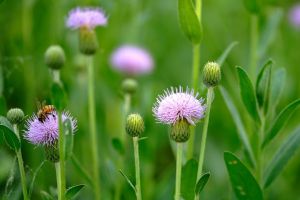
For the light purple dandelion, the flower language is 'the legendary purple, attribute dark. Legend says whoever can find a purple dandelion can obtain perfect love.
Please note: in fact, dandelions are not purple.
Autumn dandelion
The flowers contain abundant nectar, so whenever the flowering season comes, bees swarm in. Therefore its flower language is "temptation."
Flying Arrow dandelion
The dandelion crowned with the name Flying Arrow has the flower language "aiming at the marble," attribute wind.
Dandelion's application value
1. Edible value. Dandelion can be eaten raw, stir-fried, made into soup, or dressed cold, with a unique flavor. Raw: wash the tender stems and leaves of dandelion, drain, and dip in sauce; it is slightly bitter, fresh and fragrant, and refreshing. Cold dressing: blanch the washed dandelion in boiling water for 1 minute, drain, and rinse with cold water. Season with chili oil, monosodium glutamate, salt, sesame oil, vinegar, mashed garlic, etc., or mix into side dishes with different flavors according to your own taste. Filling: wash the tender stems and leaves of dandelion, blanch in water, squeeze slightly, chop, add seasonings to make a filling (meat may also be added), and wrap dumplings or buns.
Dandelion has a very good dietary therapeutic effect. 1) Dandelion porridge: 30 grams of dandelion, 100 grams of japonica rice, cooked into porridge, can clear heat and detoxify, reduce swelling and dissipate nodules;
2) Dandelion, yinchen and red date soup: 50 grams of dandelion, 50 grams of yinchen, 10 red dates, 50 grams of white sugar, made into soup, is a top-grade auxiliary therapeutic medicine for acute icteric hepatitis;
3) Dandelion and platycodon soup: 60 grams of dandelion, 10 grams of platycodon, a little white sugar, decocted together into soup, has a certain effect on carbuncles;
4) Dandelion and corn soup: 60 grams of dandelion, 60 grams of corn silk, add water and decoct to concentrate for oral use or drink as tea, used to treat heat strangury and scanty dark urine.
2. Medicinal value. Dandelion is also called bed-wetting grass; the whole plant is used as medicine, and it has a very good effect on diuresis. It is rich in carotene, vitamin C and minerals, and has an improving effect on indigestion and constipation; in addition, the leaves also have a blood-purifying effect that improves eczema and soothes dermatitis and joint discomfort, while the root has an anti-inflammatory effect and can treat gallstones and rheumatism, but it is still best not to use it without the guidance of a professional physician; the flowers decocted into medicinal juice can remove freckles, so it can be said to be a very useful aromatic herb. For fresh dandelion, choose those with clean leaves and a slight fragrance; for dried dandelion, choose those that are grayish-green, free of impurities, and dry.
3. Dandelion tea. 75 grams of dried dandelion and 1000 milliliters of water can be made into tea for drinking. Wash the dandelion, put it in a pot, add water to cover the dandelion, bring to a boil over high heat, then cover with a lid and simmer over low heat for one hour, filter out the tea residue, and drink after it cools. Dandelion tea is not suitable for people with yang deficiency and external cold or weak spleen and stomach; excessive dosage can cause mild diarrhea.
For more professional agricultural science and technology information, please scan the QR code to follow WeChat: NongXunNET

Please indicate the source when reprinting.