What kind of growing environment does bayberry cultivation require?
What kind of growing environment suits bayberry? The bayberry gets its name because its form resembles the water poplar and its taste resembles the plum; the bayberry fruit is sweet and sour, brightly colored, rich in vitamins, and extremely high in nutritional value, making it one of China's specialty fruits and deeply loved by consumers. 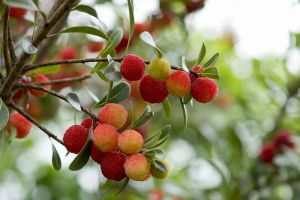
Bayberry family and genus
Myricaceae, genus Myrica
Other names for bayberry
Longjing, Zhuhong, Shengshengmei, Baidimei, Shumei
Distribution of bayberry
Bayberry is mainly produced in the Jiangsu and Zhejiang area, among which Yuyao and Cixi are world-famous hometowns of bayberry, both possessing ancient bayberry trees with an age of up to a thousand years.
There is a folk saying, "Chinese bayberry comes from Zhejiang, and Zhejiang bayberry is counted in Xianju"; the "Xianmei" of Xianju County, Taizhou City, is a specialty variety of China and has already formed a brand.
Morphological characteristics of bayberry
Bayberry is an evergreen tree that can reach more than 15 m in height, with a trunk diameter of up to 60 cm; the branches and buds are hairless, and the young branches have shield-shaped glands; the leaves are leathery, hairless on the surface, with a leaf age of about 2 years, the leaf tip gradually pointed or sharply pointed, the leaf margin above the middle with sparse sharp serrations, entire below the middle, and the leaf base wedge-shaped; sparse golden-yellow glands grow on the veins.
Bayberry flowers are dioecious; the male flowers grow in clusters in the leaf axils and are cylindrical, about 1-3 cm long; the male flowers have 2-4 ovate bracteoles and 4-6 stamens; the male flower anthers are dark red and elliptical; the bayberry fruit is dark red or purplish red and spherical, with nipple-like protrusions on the surface of the rind, and the outer pericarp is juicy and fleshy with a sweet and sour taste; bayberry blooms in April, and the fruit ripens in June-July.
Growth habits of bayberry
Bayberry likes moisture and tolerates shade, preferring slightly acidic soil with a thick humus layer; shaded and ventilated locations are very suitable for its growth. Under microclimatic conditions with relatively large light radiation, sufficient heat accumulation, and high annual accumulated temperature, it is even more suitable for producing high-quality bayberry.
For more professional agricultural science and technology information, please scan the QR code to follow WeChat: NongXunNET

Please indicate the source when reprinting.