The Lantern Kalanchoe actually has another flower name
The Lantern Kalanchoe is a perennial succulent herb with woody stems and many branches. The new branches are soft and often drooping, the leaves are opposite, long ovate, slightly succulent, and the flowers are pale red and tubular. Now let me introduce the Lantern Kalanchoe to you!
Other names of the Lantern Kalanchoe
Pearl Wind Chime, Red Lantern, Trailing Bellflower Begonia.
Morphological characteristics of the Lantern Kalanchoe
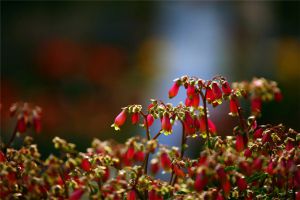
The Lantern Kalanchoe belongs to the Crassulaceae family, Kalanchoe genus. Because its flowers closely resemble small lanterns and the flower color is red, people also call it Red Lantern and Trailing Bellflower Begonia. It is a perennial herbaceous plant. The stems are woody and many-branched, and the new branches are soft and often drooping. The leaves are opposite, long ovate, and slightly succulent. The flowers are red, tubular, and the tip has 4 petals that are slightly separated. Its appearance closely resembles a small lantern, hence the name Lantern Kalanchoe. Whenever the Lantern Kalanchoe blooms, strings of flowers are as bright and fresh as red lanterns, small and lovely, and very endearing.
Growth habits of the Lantern Kalanchoe
The Lantern Kalanchoe grows best when planted in a well-aerated earthenware pot, but it is not attractive indoors, so it can be placed in an outer plastic or porcelain pot, or planted directly in a small purple clay pot or plastic pot. When planting, place a layer of crushed charcoal pieces or crushed hard plastic foam pieces at the bottom of the pot to improve aeration.
Although the Lantern Kalanchoe is not very picky about soil, it is prone to root rot in heavy clay, and grows best in loose, fertile, slightly acidic sandy loam. For home pot cultivation, it is best to mix leaf mold and garden topsoil in equal amounts, then add 5% to 8% sand as the growing medium. When planting, add a little bone meal or nitrogen-phosphorus-potassium compound fertilizer as a base fertilizer.
How to grow the Lantern Kalanchoe
The Lantern Kalanchoe is relatively drought-tolerant and afraid of waterlogging. Under the dry air conditions of high-rise buildings, it grows well; pay attention to timely ventilation.
The Lantern Kalanchoe likes fertilizer. Half a month after seedlings are potted and planted, or half a month after old plants are divided, apply 2 to 3 times a nitrogen-based liquid fertilizer to promote stem and leaf growth. After flowering, apply one nitrogen-based liquid fertilizer to help it recover vigor. At other times, except for stopping fertilization in summer, only nitrogen-phosphorus-potassium compound fertilizer may be applied. When fertilizing, do not get fertilizer on the leaves, otherwise the leaves are prone to rot.
The Lantern Kalanchoe likes a sunny, well-lit environment. Except for slight shading at noon in midsummer, it should be placed in a sunny spot at other times. It needs at least 4 hours of direct light per day to grow vigorously.
The most suitable growing temperature for the Lantern Kalanchoe is 15°C to 25°C. Above 30°C, growth slows and it enters a semi-dormant state, which means that in summer it basically does not grow. Below 10°C, growth stops; below 8°C, the leaves turn red and the flowering period is delayed; below 0°C, it is easily frozen to death.
Appreciation of beautiful Lantern Kalanchoe pictures
For more professional agricultural science and technology information, please scan the QR code to follow WeChat: NongXunNET

Please indicate the source when reprinting.