What are the characteristics and symbolic meaning of spiderwort?
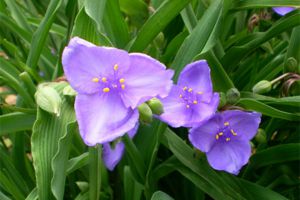
Spiderwort is a perennial herbaceous plant in the genus Tradescantia of the Commelinaceae family. Its stems are much branched, somewhat fleshy, and purplish red; its petals are blue-purple. Because of its long flowering period and its unusual, elegant plant form, it has very high ornamental value.
Other names for spiderwort
Other names for spiderwort include purple spiderwort, purple brocade grass, purple leaf grass, purple bamboo plum, and so on.
Growth habits of spiderwort
Spiderwort likes an environment with plenty of sunlight, but it can also tolerate partial shade. It is vigorous by nature and cold-tolerant, and can overwinter outdoors in North China.
Spiderwort likes a humid climate environment and requires the relative air humidity of the growing environment to be 60-75%. It is not strict about soil and does best in loose, moist, and well-drained soil. It is relatively tolerant of poor soil, and no pests or diseases have been observed.
Morphological characteristics of spiderwort
The stems of spiderwort are much branched, somewhat fleshy, and purplish red; the lower part is creeping, often producing fibrous roots at the nodes, and the upper part is nearly upright. The leaves are alternate, lanceolate, entire, with the base clasping the stem and forming a leaf sheath, and the underside is purplish red. The flowers are densely borne on a forked flower stalk, with 3 petals, blue-purple, and broadly ovate. The capsule is elliptical, with 3 raised ridge lines, and the seeds are triangular-semicircular and light brown.
For more professional agricultural science and technology information, please scan the QR code to follow WeChat: NongXunNET

Please indicate the source when reprinting.