What are the characteristics of Aristolochia tubiflora? A detailed guide
Aristolochia tubiflora has the following characteristics. Aristolochia tubiflora belongs to the family Aristolochiaceae and the genus Aristolochia. Its other names are Yidianxue, Duyiwei and Hongbaiyao. It is native to Henan, Hubei, Hunan, Sichuan and other places, and is now fairly widely distributed in southern China. Morphological characteristics: Aristolochia tubiflora is a herbaceous vine; its roots are slender and cylindrical, yellow-brown; the stems are hairless and have furrows when dry; the young branches and leaf stalks of Aristolochia tubiflora exude a slightly red sap when broken. The leaves have a papery or membranous feel, are ovate-cordate, with a slightly blunt tip, a shallowly cordate base, drooping lobes on both sides, and entire margins; the upper surface is dark green, the lower surface is light green or powdery green, and the leaf surface is often densely covered with small dots; the capsule is brown and oblong, and the fruit stalk splits into 6 strips when the fruit dehisces; the seeds are ovate, with raised small dots on the back and a sunken raphe on the ventral side. The flowering period is from April to August, and the fruiting period is from October to December. 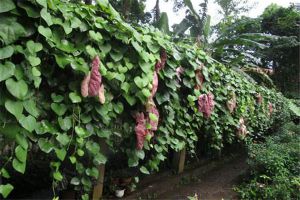
Aristolochia tubiflora, also known as Yidianxue, gets its name because its young branches and leaf stalks exude a slightly red sap when broken. It is a herbaceous vine that can be used as medicine. In folk practice it is mostly used to clear heat and detoxify, and it can be used to neutralize snake venom.
Family and genus of Aristolochia tubiflora
Aristolochiaceae, Aristolochia
Other names of Aristolochia tubiflora
Yidianxue, Duyiwei, Hongbaiyao.
Geographical distribution of Aristolochia tubiflora
Native to Henan, Hubei, Hunan, Sichuan and other places, it is now fairly widely distributed in southern China.
Morphological characteristics of Aristolochia tubiflora
Aristolochia tubiflora is a herbaceous vine; its roots are slender and cylindrical, yellow-brown; the stems are hairless and have furrows when dry; the young branches and leaf stalks of Aristolochia tubiflora exude a slightly red sap when broken. The leaves have a papery or membranous feel, are ovate-cordate, with a slightly blunt tip, a shallowly cordate base, drooping lobes on both sides, and entire margins; the upper surface is dark green, the lower surface is light green or powdery green, and the leaf surface is often densely covered with small dots; the capsule is brown and oblong, and the fruit stalk splits into 6 strips when the fruit dehisces; the seeds are ovate, with raised small dots on the back and a sunken raphe on the ventral side. The flowering period is from April to August, and the fruiting period is from October to December.
Growth habits of Aristolochia tubiflora
Aristolochia tubiflora mostly grows in shady, damp places under forests. The flowers of Aristolochia tubiflora can emit a rotting-flesh odor to attract insects; after entering the floral tube, the insects find it difficult to crawl out because they are blocked by the hairs on the inner side of the flower. After the pollen matures, it falls onto the backs of the insects; at this time the hairs shrivel, and the insects fly out to carry out pollination.
Medicinal value of Aristolochia tubiflora
The roots and fruits are used as medicine, with effects of clearing lung heat, relieving cough and calming asthma.The roots can be used to clear heat and detoxify, relieve pain, and are used for stomach pain and venomous snake bites. The whole plant can be used for traumatic injuries.
For more professional agricultural science and technology information, please scan the QR code to follow WeChat: NongXunNET

Please indicate the source when reprinting.