What are the other names for Canna? A list of common aliases
Canna is a commonly used flowering ornamental plant in subtropical and tropical regions. Because of its large flowers and brilliant colors, it has become a new favorite in home cultivation. Below is some basic information about Canna; let us get to know this plant together.
Genus and family of Canna
Canna is a perennial herbaceous plant with rhizomes, and it is a commonly used flowering ornamental plant in tropical and subtropical regions.
Aliases of Canna
Canna is also called red canna, small-flowered canna, and small banana.
Distribution range of Canna
Canna is native to tropical regions such as the Americas, India, and the Malay Peninsula, and is distributed in India as well as various places in the north and south of mainland China, growing in areas at an altitude of 800 m. It has now been introduced and cultivated artificially, and can be cultivated throughout the country.
Morphological characteristics of Canna
The entire Canna plant is green, reaching about 1.5 m in height. The leaves are ovate-oblong, 10-30 cm long and up to 10 cm wide.
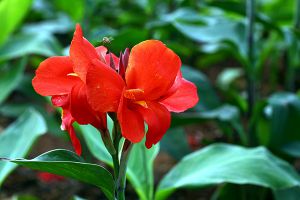
Canna flowers are relatively sparse, in racemes, rising above the leaves; the flowers are red and solitary.
The flower buds are ovate, green, about 1.2 cm long. There are 3 sepals, lanceolate, about 1 cm long, green and sometimes tinged with red. The corolla tube is less than 1 cm long, and the corolla lobes are lanceolate, 3-3.5 cm long, green or red.
The outer staminodes are 3-2 in number, bright red, of which 2 are oblanceolate, 3.-4 cm long and 5-7 mm wide; the other, if present, is especially small, 1.5 cm long and only 1 mm wide.
The labellum is lanceolate, 3 cm long, curved; the fertile stamen is 2.5 cm long, and the anther thecae are 6 mm long; the style is flat, 3 cm long, half united with the filament of the fertile stamen.
The capsule of Canna is green, long ovate, with soft spines, about 1.2-1.8 cm long. The flowering and fruiting period is generally from March to December.
Flower language of Canna
The flower language is: a solid future.
According to Buddhist belief, Canna was transformed from blood flowing from the Buddha's toe, and it is a large flower.
In the sunlight, Canna blooming in the scorching heat makes people feel its strong will to exist.
For more professional agricultural science and technology information, please scan the QR code to follow WeChat: NongXunNET

Please indicate the source when reprinting.