With its distinctive appearance, the daggerpod (Anelsonia eurycarpa) is a delightful plant.
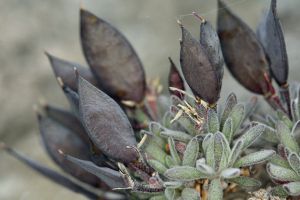
The daggerpod (wings of the earth) is a perennial succulent herbaceous plant. After the fruit ripens, the valves and seeds fall away, leaving only a membranous septum, like a cicada's wing; it belongs to the tribe Arabideae in the family Brassicaceae. Its scientific name was given in honor of the botanist Aven Nelson. It is now regarded as a separate genus, and this genus contains only the single species Anelsonia eurycarpa.
Introduction to the daggerpod (wings of the earth)
Its Chinese name is daggerpod, and its Latin scientific name is Anelsonia eurycarpa (A. Gray) J.F.Macbr. & Payson; it is also called "wings of the earth".
The daggerpod (wings of the earth) is a herbaceous plant in the order Papaverales, family Brassicaceae, tribe Arabideae; it is very small, with rosette leaves that are grayish-green, soft, succulent and hairy. It has dense inflorescences of small white flowers. The fruit is 2 to 3 cm, oval. After the fruit ripens, the valves and seeds fall away, leaving only a membranous septum, like a cicada's wing.
Distribution of the daggerpod (wings of the earth)
The daggerpod (wings of the earth) is native to the dry, gravelly sunny slopes of the Rocky Mountains in North America. It grows in high-altitude mountainous areas throughout the western United States.
For more professional agricultural science and technology news, please scan the QR code to follow WeChat: NongXunNET

Please indicate the source when reprinting.