What are the characteristics and symbolic meanings of the sensitive plant (Mimosa pudica)?
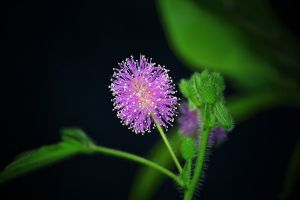
Other names of the sensitive plant
Ganyingcao, Zhixiucao, Huhecao, Pachoucao, Jianxiaocao, Fuqicao, Haixiucao
Growth habits of the sensitive plant
It is native to the tropical regions of the Americas and is now widely distributed in tropical regions around the world. It is produced in Taiwan, China, Fujian, Guangdong, Guangxi, Yunnan and other places. It grows in open wastelands and thickets, and is often cultivated for ornamental purposes in the Yangtze River basin. The sensitive plant likes a warm, humid environment with plenty of sunlight. It is suitable for well-drained, sandy loam rich in organic matter. The plant is robust, grows quickly, and has strong adaptability.
Flower language of the sensitive plant
Shyness, sensitivity, politeness
If the leaves of the sensitive plant are touched by hand, or if it is watered or encounters a typhoon, they will curl up. It is like bowing to people. It is a very polite plant. Therefore, its flower language is "politeness." Anyone born under the blessing of this flower is well-behaved and liked by older people. However, it can make peers feel a sense of fear, so one should occasionally relax. Because one is too serious and rule-abiding, even the opposite sex may be afraid and not dare to approach.
Shyness: lightly touching the sensitive plant makes its leaves close immediately, and even a breeze passing by can cause this situation, like a shy girl. Therefore, its flower language is shyness. A person born under the blessing of this flower has a shy and timid personality and is very afraid of strangers. They are especially keen in feeling and have strong self-esteem. However, when with people who understand them, they will be much more relaxed and at ease. They make friends valuing quality over quantity, and like feelings that flow steadily like a long stream.
For more professional agricultural science and technology information, please scan the QR code to follow WeChat: NongXunNET

Please indicate the source when reprinting.