Is the Desert Rose easy to grow? A detailed analysis of its growing difficulty
The Desert Rose, also known as Tianbao flower, is a succulent plant of the Apocynaceae family that likes a high-temperature, dry and sunny environment, tolerates extreme heat but not cold; it is named Desert Rose because its place of origin is close to deserts and its flowers are red like roses; its places of origin are Kenya and Tanzania in Africa. When in full bloom it is beautiful and is often used as a potted ornamental.
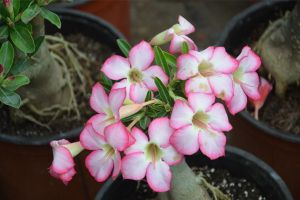
Other names of the Desert Rose
Tianbao flower
Growing habits of the Desert Rose
It favors a high-temperature, arid, sunny climate environment; it likes calcium-rich, loose, breathable, well-drained sandy loam, is not tolerant of shade, avoids waterlogging, avoids concentrated fertilizer and raw fertilizer, fears cold, and its optimal growing temperature is 25-30°C.
In summer it can be placed outdoors in a sunny spot for care without shading, because the Desert Rose is drought-tolerant and needs sufficient watering to keep the soil moist. In winter watering must be moderated, and the overwintering temperature should be kept above 10°C so that it sheds its leaves and goes dormant. During cultivation, apply organic fertilizer 2 to 3 times a year as appropriate.
For propagation, in summer select 1- to 2-year-old branches about 10 cm long and cut them off; after the cut end dries slightly, insert them into a sand bed, and they will root in 3 to 4 weeks. It can also be propagated in summer by air layering. If seeds can be collected, sowing propagation can also be carried out.
In the south, the flowering period is from May to August on the Gregorian calendar; it loves light and warmth; therefore during the warm and humid growing season, sunlight is essential to promote photosynthesis. Long-term excessive shade makes the branches and leaves soft and drooping, and it is then very difficult for it to bud flowers again. Sufficient sunlight enables normal flower bud differentiation.
The flower language of the Desert Rose
Love you unswervingly
For more professional agricultural science and technology information, please scan the QR code to follow WeChat: NongXunNET

Please indicate the source when reprinting.