How Many Alternative Names Does the Camellia Have? What You Know May Just Be Its Alias
Because of its graceful plant form, dark green glossy leaves, and brilliant, colorful flowers, the camellia is treasured by the world horticultural community. There are extremely many camellia varieties, and it is a traditional ornamental flower of China. It originated in southwest China and is mainly distributed in the southern provinces such as Sichuan, Yunnan and Guangdong.
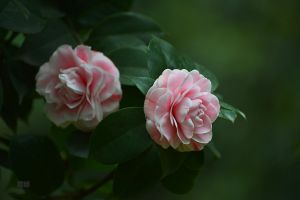
Camellia aliases
Camellia is also called camellia, camellia flower
Camellia growing habits
Camellia is a shrub or small tree plant of the genus Camellia in the family Theaceae.
Camellia fears wind and loves sunlight, and the planting environment is best on high, refreshing terrain with good air circulation. It likes a warm and humid environment.
The soil is best as loose, fertile sandy loam, loess or humus soil, with good drainage.
The suitable growing temperature is 20~32°C. Growth stops above 29°C, and at 35°C the leaves will show scorching. A certain temperature difference is required. Most varieties can tolerate a low temperature of -8°C.
Main camellia varieties
There are about 2000 camellia varieties, which can be divided into 3 major categories and 12 flower forms. By 2013 China had more than 306 camellia varieties.
Single-petal type - Petals in 1-2 whorls, 5-7 pieces, connected at the base, mostly tubular, fertile.
Semi-double type - Petals in 3-5 whorls, about 20 pieces, up to nearly 50 in some.
Double type - Petals in 3-5 whorls, about 20 pieces, up to nearly 50 in some.
Most stamens become petal-like, the petals naturally increase, and the number of petals is more than 50.
Camellia propagation methods
There are many propagation methods for camellia, and both sexual reproduction and asexual reproduction can be used, among which cutting and approach grafting are the most commonly used.
For more professional agricultural science and technology information, please scan the QR code to follow WeChat: NongXunNET

Please indicate the source when reprinting.