What are the other names for the succulent plant Buddha's Seat Lotus (Sempervivum)?
Other names for Buddha's Seat Lotus
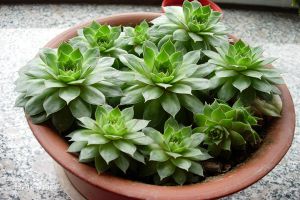
Buddha's Seat Lotus, of the Crassulaceae family, genus Sempervivum. Also called Hen and Chicks (Sempervivum), Guanyin Lotus, and Guanyin Seat Lotus.
Morphological characteristics of Buddha's Seat Lotus
Buddha's Seat Lotus is loved by everyone mainly for its special leaf shape. Its body is relatively small, and multiple leaves combine to form a blooming lotus, with star-shaped, pink flowers.
The leaf color of Buddha's Seat Lotus is rich in variation, including gray-green, dark green, yellow-green, red-brown and other colors. The leaf tip color also varies, including purplish-red, green, etc. There are many varieties, and the diameter of the leaf rosette ranges from 3 cm to 15 cm, with fine dense serrations along the leaf margins.
A well-developed Buddha's Seat Lotus will produce a ring of small rosettes below the large rosette, and at the end of spring each year it will also produce red stolons similar to those of spider plants from the lower part of the leaf cluster, with rosette-shaped plants growing at the tips of the stolons.
Landscape value of Buddha's Seat Lotus
Buddha's Seat Lotus can be planted alone as a small potted plant to beautify the environment.
Buddha's Seat Lotus is often planted indoors together with Cobweb Houseleek (Sempervivum arachnoideum), and can be planted beside rocks and stone walls.
Buddha's Seat Lotus is not large in shape, has many varieties, and comes in different colors. The difference between the leaf tip and leaf blade colors makes it even more eye-catching. Many succulent enthusiasts like to collect different varieties and grow them together, each showing its own charm.
For more professional agricultural science and technology information, please scan the QR code to follow WeChat: NongXunNET

Please indicate the source when reprinting.