In what environment does Kerria japonica grow with the most advantage?
Kerria japonica has been a favorite subject of literati and poets since ancient times. Kerria stands out among the flowers, and each leaf and each blossom is lovely in its abundance. Today let us get to know this lovely plant.
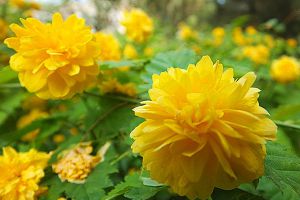
Genus and family of Kerria japonica
Kerria japonica is a shrub plant of the genus Kerria in the subfamily Rosoideae, and it is a woody plant.
Alternative names of Kerria japonica
Kerria japonica is also called Di Tang, Feng Tang Hua, Huang Du Mei, Jin Di Tang Mei, and Huang Yu Mei.
Place of origin of Kerria japonica
It is native to China from North China to South China, and is distributed in Anhui, Zhejiang, Jiangxi, Fujian, Henan, Hunan, Hubei, Guangdong, Gansu, Shaanxi, Sichuan, Yunnan, Guizhou, Beijing, Tianjin and other provinces.
Morphological characteristics of Kerria japonica
Kerria japonica reaches 1-2 m in height, with green, cylindrical, hairless branchlets.
The leaves are alternate, triangular-ovate or ovate, with a long acuminate apex and a rounded base; the petiole is 5-10 mm long and hairless.
The flowers are solitary, borne at the tips of the current year's lateral branches, with hairless pedicels; the flowers are 2.5-6 cm in diameter; the sepals are ovate-elliptic, with an acute apex and a small mucro, entire, hairless, and persistent in fruit; the petals are yellow, broadly elliptic, with a concave apex, and are 1-4 times longer than the sepals.
The achene is obovate to hemispherical, brown or blackish brown, hairless, and wrinkled.
The flowering period of Kerria japonica is from April to June, and the fruiting period is from June to August.
For more professional agricultural science and technology information, please scan the QR code to follow WeChat: NongXunNET

Please indicate the source when reprinting.