What are the characteristics of tuberose? A comprehensive guide in one article
Tuberose, a flower that wins by its "night fragrance," and because of this unique trait, it has won the affection of many people. It is the most commonly used and most important filler flower in many bouquets and flower arrangements. Let's take a look.
The genus and family of tuberose
Tuberose belongs to the Amaryllidaceae family, a perennial bulbous herbaceous flower, a bulb flower.
Alternative names for tuberose
Tuberose is what people often call "moonlight fragrance" and "night-blooming flower."
Origin of tuberose
It is native to Mexico and South America, and is cultivated more in northern China than in the south. In recent years, some flower growers in Xinye, Shucheng and other towns of Shuyang County, Jiangsu Province introduced and trial-planted it, achieved success, and earned relatively high income. It and the night-blooming flower native to tropical America do not belong to the same family of flowers.
Morphological characteristics of tuberose
Tuberose is a winter-dormant plant, with linear basal leaves and small short stem leaves.
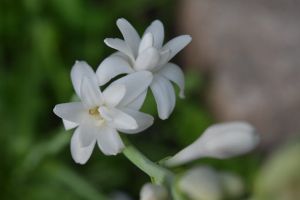
The spike flower cluster is terminal, with 12-32 flowers per spike, white flowers, funnel-shaped, with a rich fragrance that is strongest at night, hence the name.
When planted in the open ground, the flowering period is usually from early July to early November, with the peak flowering period in August-September, making it a summer cut-flower type. It grows about 80 cm tall, with basal leaves, lanceolate, and the base slightly tinged with red.
For more professional agricultural science and technology information, please scan the QR code to follow WeChat: NongXunNET

Please indicate the source when reprinting.