What are the characteristics of the growth habits of Exochorda racemosa?
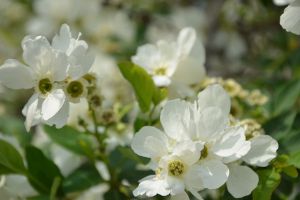
Exochorda racemosa, also known as cocoon flower and golden melon fruit, is a deciduous shrub in the Rosaceae family. Its flowers are as white as snow, and its tree form is elegant and beautiful. It is an ornamental flower suitable for planting in courtyards or growing in pots. Come and take a look with the editor at what kind of flower this Exochorda racemosa is!
Family and genus of Exochorda racemosa
Rosaceae, genus Exochorda
Aliases of Exochorda racemosa
Cocoon flower, jiuhuotou, golden melon fruit; Latin scientific name: Exochorda racemosa
Origin of Exochorda racemosa
Exochorda racemosa comes from the Jiangsu and Zhejiang area of China, and it is currently distributed in North China and Central China.
Growth habits of Exochorda racemosa
Exochorda racemosa likes a warm and humid climate. It likes light but is also tolerant of shade, and it has strong cold resistance; it does not demand much from the soil, and can grow in acidic soil, neutral soil, and poor soil. Of course, it grows more vigorously and has stronger sprouting ability in fertile and breathable soil.
Morphological characteristics of Exochorda racemosa
Exochorda racemosa is a deciduous shrub, but it often appears in the form of a small tree. The plant can reach 5 m in height. The branches of Exochorda racemosa are hairless and angular, and are reddish brown when young. The leaves are oblong or obovate, with rounded and blunt tips, simple leaves alternate, the petioles are relatively short, and the leaf backs are grayish white; the flowers of Exochorda racemosa are bisexual, the petals are obovate, about 1.5 cm long, with slightly blunt tips, and the calyx tube is bell-shaped.
Common varieties of Exochorda racemosa
Exochorda giraldii, this type has longer petioles, around 2 cm, and they are red, hence the name; the pedicels are extremely short, almost absent.
Exochorda serratifolia, its main characteristic is that there are sharp serrations above the middle of the leaf blade, and the young parts are slightly covered with soft hairs.
For more professional agricultural science and technology information, please scan the QR code to follow WeChat: NongXunNET

Please indicate the source when reprinting.