How do you grow Monilaria moniliformis? It grows better in this kind of environment
Other names for Monilaria moniliformis
Jade Rabbit Ear
Morphological characteristics of Monilaria moniliformis
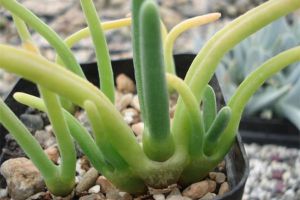
The leaves of Monilaria moniliformis are semi-transparent and rich in a granular texture, very cute. It also has branches and tends to grow in clusters.
The flowers are generally white, the fruit is shaped like a yuanbao, and there are 50-150 seeds.
The stem is thick, fleshy and jointed. The leaves are fleshy with two forms: during the growing period the leaves are slender and opposite, often not connected, while the dormant leaves are short and thick, hemispherical in shape, with the opposite leaves highly connected.
Growth habits of Monilaria moniliformis
Native to South Africa, it is a very drought-tolerant succulent. It does not need much sunlight, and in summer it must be shaded, ventilated and given no water.
When the summer temperature is too high it will dry up and directly enter a dormant state, and after enduring until autumn, watering will restore growth.
In spring and autumn it can be watered frequently, which can keep the rabbit ears standing upright. When short of water, the rabbit ears will droop.
Home care methods for Monilaria moniliformis
Suitable growing temperature
The suitable growing temperature for Monilaria moniliformis is generally 15-25 degrees, and in winter not lower than 5 degrees.
When the temperature exceeds 35 degrees C, the entire plant will wither and directly enter the dormant period.
Soil
For artificial cultivation, peat, vermiculite and perlite can generally be used, along with a relatively large amount of granular soil (good for drainage and aeration); because the root system is well developed, use a deeper pot.
Water and fertilizer management
Watering: during the growing period, water thoroughly when the soil is dry; during the dormant period, no water is needed.
Fertilizing: during the growing period, a light fertilizer can be applied; do not fertilize too frequently.
Propagation methods
The main propagation method of Monilaria moniliformis is sowing, and it can also be propagated by division.
Suggested planting combination: Sedum rubrotinctum
For more professional agricultural science and technology information, please scan the QR code to follow WeChat: NongXunNET

Please indicate the source when reprinting.