What other names does the hollyhock have? Many people don't know these names
The hollyhock has large leaves, abundant flowers, brilliant colors, and a long flowering period, and is a relatively commonly cultivated flower in gardens. Dwarf varieties can be grown as potted flowers, and the stems can also be cut for use as cut flowers, for vase arrangements or for flower baskets, bouquets, and so on.
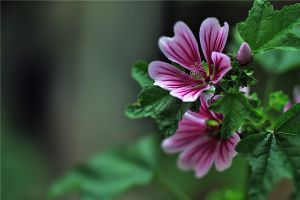
Other names for the hollyhock
The hollyhock, also called yizhanghong, shujihua, rongkui, wukui, weizukui, hukui, doupeng hua, and shujie hua, is a perennial herbaceous flowering plant in the Malvaceae family, genus Alcea. Because it originated in Sichuan, China, it is called shukui. And because it can reach about one zhang in height and its flowers are mostly red, it is called yizhanghong.
Morphological characteristics of the hollyhock
The hollyhock is a biennial herbaceous plant; the plant can reach 2 m to 3 m in height, with an upright, stiff stem, growing in clumps, unbranched, and the whole plant covered with stellate hairs and bristles. The leaves are nearly round-cordate or oblong, 6 cm to 18 cm long and 5 cm to 20 cm wide, with the basal leaves larger; the leaves are rough, with stellate hairs on both sides, and the petiole is 5 cm to 15 cm long.
The flowers are solitary or nearly clustered in the leaf axils, sometimes arranged in racemes. There are 6 to 9 bracteoles, broadly lanceolate, united at the base and attached outside the calyx tube. There are 5 sepals, ovate-lanceolate. The corolla is 6 to 13 cm in diameter, in colors such as purple, purplish red, pink, pale red, purple-black, yellow, and white, and there are also bicolor varieties with differently colored edges. There are 5 or more petals, obovate, with wavy and wrinkled or toothed margins, single, semi-double, to double. There are many stamens, with the anthers united into a tube surrounding the style; the style is linear and protrudes above the stamens. The capsule is flattened and round, and the seeds are kidney-shaped, with the back edge raised like a rooster's comb and oblique lines on the sides; the thousand-seed weight is about 9.2 grams.
Growing habits of the hollyhock
The hollyhock likes full sunlight and tolerates partial shade, but dislikes waterlogging. It has strong saline-alkali tolerance and can still grow in soil containing 0.6% salt. It is cold-tolerant and can overwinter safely in the open ground in North China. It grows well in loose, fertile, well-drained sandy soil rich in organic matter.
Symbolic meaning of the hollyhock's flower language
The flower language of the hollyhock is gentleness.
If you want to give flowers to your loved one or girlfriend to praise her gentle personality and her qualities as a good wife and loving mother, then you might consider giving red hollyhocks, which represent the flower language of gentleness. Red hollyhock, that is, red hollyhock, is very beautiful, with bright colors that give a fresh feeling, and is very popular. Red hollyhock is especially suitable for planting in courtyards, along roadsides, and in sites arranged as flower borders in good environments. It can also form lush hedges and flower walls, beautifying the garden environment. It brings a gentle feeling to the owners of the hedges and flower walls.
Value of the hollyhock
1. Ornamental value. The hollyhock has large leaves, abundant flowers, brilliant colors, and a long flowering period, and is a relatively commonly cultivated flower in gardens. It is suitable for planting beside buildings, beside rockeries, or as accents in flower beds and lawns, planted in rows or clumps. Dwarf varieties can be grown as potted flowers and displayed in front of doors, but should not be kept indoors for long. The stems can also be cut for use as cut flowers, for vase arrangements or for flower baskets, bouquets, and so on.
2. Medicinal value. The roots, stems, leaves, flowers, and seeds of the hollyhock are medicinal materials; they clear heat and detoxify, and when taken orally treat constipation, neutralize pufferfish poison, promote urination, and treat dysentery. When used externally, they treat sores, ulcers, burns, and other conditions.
3. Other value. The roots of the hollyhock contain sugars and alcohol compounds. The flowers contain anthocyanins, red pigments, glucose, and hollyhock glycoside. The seeds contain fatty oil, of which unsaturated free alcohols make up 34.88%. The stems can be used as weaving fiber material, and the anthocyanins extracted from the flowers can serve as a food colorant.
Appreciation of hollyhock pictures
For more professional agricultural science and technology news, please scan the QR code to follow WeChat: NongXunNET

Please indicate the source when reposting.